








Open Secrets: Harnessing OSINT For Competitive & Cyber Advantage
0 min read

Nick Savvides
Every organisation sits atop a vast field of open information: public records, digital footprints, market signals and the endless churn of online discourse. The challenge isn’t access anymore, but discernment. Those who can turn open data into strategic foresight hold an undeniable advantage.
Open-source intelligence (OSINT) is a capability that redefines how organisations perceive risk and opportunity. When structured correctly, OSINT transforms public information into a competitive asset that offers clarity in a landscape clouded by digital noise.
What is OSINT?
OSINT, short for open-source intelligence, refers to the systematic collection and analysis of data that’s publicly available. In practice, it means drawing intelligence from open sources such as news reports, government publications, social media, corporate filings, geospatial data and others. Unlike classified or proprietary information, OSINT relies entirely on content that’s legally and openly accessible.
Security analysts, law enforcement and enterprises use OSINT to uncover relationships, detect anomalies and anticipate risk. It is foundational to modern intelligence work because it converts fragmented public data into cohesive, contextual insight.
Beyond data collection
Within the cybersecurity sphere, OSINT intelligence is often misunderstood as simple data scraping or open-web monitoring. In reality, it represents a disciplined methodology: a process that fuses collection, validation and contextual analysis to convert public information into actionable outcomes.
It draws from countless inputs like code repositories, leaked databases, industry documentation and metadata embedded in everyday files. The sophistication lies in the synthesis: how signals become patterns, and patterns become foresight.
At its most advanced, the meaning of OSINT is somewhat predictive. It can expose behavioural trends, geopolitical triggers or early indicators of compromise before they escalate into an incident. In a data-first world, that level of foresight could very well be the new perimeter.
How modern OSINT really works
The practice of open-source intelligence was born long before the Internet. During the Second World War, intelligence officers tracked public radio broadcasts, intercepted trade data and analysed newspapers to anticipate political and military shifts. The principle remains unchanged: the most potent insights often come from information already in plain sight.
Today, OSINT operates on a far larger scale. Every search engine query, social post, company filing and API call contributes to an expanding ocean of accessible data. Analysts collect and interpret these fragments to uncover connections that structured systems overlook.
A modern OSINT program might draw from:
- News outlets, industry publications and verified online media.
- Social and professional networks where sentiment, recruitment patterns and partnerships reveal movement.
- Forums, blogs and dark-web communities where threat actors communicate or leak credentials.
- Open datasets, from IP addresses and domain records to corporate registries and satellite imagery.
- Academic and technical repositories containing early research or vulnerability disclosures.
Yet the value of OSINT intelligence has little to do with how many sources are scanned. It begins with intent. Security and intelligence teams first define a question: ”What risk are we trying to measure?” or “Which behaviours are we trying to predict?” Only then does the collection begin, with a targeted and deliberate approach.
Why OSINT now defines competitive and cyber advantage
For modern enterprises, market competition and cyber defence now share the same terrain: data. The same signals that reveal consumer sentiment can also expose the early stages of a phishing campaign or a compromised supplier network.
- Strategic awareness — OSINT is what equips decision-makers with visibility that extends beyond their perimeter, into competitors’ movements, regulatory trends and evolving market narratives. It replaces assumption with evidence.
- Operational resilience — Security teams leverage open-source intelligence to identify vulnerabilities in real time. These could be unsecured assets, dark web chatter or emerging exploits targeting their sector. It’s the digital equivalent of knowing where the next storm will form.
- Data-centric protection — As enterprises shift toward unified data strategies, OSINT complements data-loss prevention and behavioural analytics by feeding fresh, external intelligence into existing control systems. This integration sharpens both policy and response.
What distinguishes mature organisations is not their access to open-source intelligence, but their ability to connect it with broader data-protection architectures. After all, insight without enforcement is noise. OSINT without integration is wasted potential.
Turning intelligence into architecture
OSINT delivers its most significant value when it stops being a side practice and becomes part of an organisation’s operating model. In mature enterprises, open-source intelligence is woven into risk, security and competitive strategy.
The process begins with structure:
1. Collection
Intelligence isn’t about collecting everything, but collecting what matters. Mature OSINT programs automate data capture across credible, legally accessible sources. Automation widens reach, but precision defines value. Each data stream is curated around defined business questions or risk indicators, creating a live, traceable view of the organisation’s external environment.
2. Validation
The open web is polluted with misinformation, duplication and bias. Verification is therefore the stage where quality becomes non-negotiable. Cross-referencing sources, assessing reputation and applying automated credibility scoring transform unverified data into something usable. Machine learning models can detect anomalies and outliers, while human analysts apply contextual reasoning.
3. Contextual analysis
This is where open-source intelligence earns its value. Analysts map external data against internal telemetry — threat alerts, network logs, user behaviour — to identify correlations that reveal exposure or opportunity. A vulnerability discussed on a dark web forum might align with an internal configuration weakness, or a surge in social chatter might mirror an emerging reputational risk. The synthesis of internal and external perspectives converts isolated data points into strategic foresight.
4. Action
Mature enterprises route OSINT insights directly into operational systems: incident response playbooks, vulnerability management workflows and executive dashboards. At this stage, intelligence becomes measurable: risks mitigated, breaches averted, decisions accelerated. When OSINT data is integrated with behavioural analytics and machine-learning models, detection sharpens and leadership gains visibility that anticipates rather than reacts.
The Australian context: clarity in a volatile landscape
In Australia, the stakes are rising. The Privacy Act 1988, the Australian Privacy Principles (APPs) and the Security of Critical Infrastructure Act 2018 (SOCI) now place greater accountability on enterprises handling sensitive data. Breaches must be reported promptly to the Office of the Australian Information Commissioner (OAIC), which means every exposure is a reputational and regulatory risk.
Simultaneously, the region faces an escalating cyber threat environment: coordinated ransomware campaigns, state-linked espionage and vulnerabilities spreading through shared supply chains across Asia-Pacific. For Australian organisations, OSINT is no longer just a research tool, but an early-warning system.
By monitoring open data for leaked credentials, brand misuse or chatter about critical suppliers, enterprises can detect exposure before it becomes exploitation. When combined with internal telemetry, this intelligence helps executives anticipate rather than apologise. It also provides invaluable visibility into regional market trends, competitor movements and regulatory sentiment.
Intelligence as the new perimeter
The open world now defines the threat surface. Every piece of public information is either a vulnerability or an advantage, depending on who interprets it first.
For modern enterprises, open-source intelligence (OSINT) is now foundational. When integrated into a data-first security strategy, it extends visibility beyond the firewall, enabling teams to anticipate threats, understand behaviour and protect information wherever it lives.
Through a unified architecture that connects data, people and context, Forcepoint transforms intelligence into continuous protection. Our AI-powered classification models and 1,700+ pre-built data templates simplify compliance across more than 80 countries, while policy enforcement spans every vector: cloud, web, endpoint, email and network.
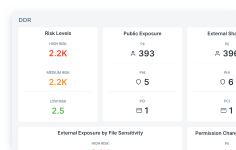
Forcepoint Data Detection and Response (DDR) is a breakthrough capability that moves beyond traditional data loss prevention. DDR actively detects, analyses and mitigates risky data movement in real time, combining machine learning, behavioural analytics and OSINT-informed insights to stop incidents before they escalate.
Discover how Forcepoint can help your organisation turn intelligence into action. Speak with an expert today.

Nick Savvides
Read more articles by Nick SavvidesNick Savvides serves as Field CTO & Head of Strategic Business, APAC at Forcepoint. In this role, he is responsible for growing the company’s strategic business with its key customers in the region. This involves taking the lead to solve customers’ most complex security issues while accelerating the adoption of human-centric security systems to support their business growth and digital transformation. In addition, Savvides is responsible for providing thought leadership and over-the-horizon guidance to CISOs, industry and analysts.
In the Article

X-Labs
Get insight, analysis & news straight to your inbox

To the Point
Cybersecurity
A Podcast covering latest trends and topics in the world of cybersecurity
Listen Now