What Is Data Loss Prevention (DLP)? A Complete Guide
0 minutos de lectura
Lionel Menchaca
Quick answer: Data loss prevention (DLP) is a set of technologies and policies that finds sensitive data, monitors how it moves and stops it from leaving through channels it shouldn't, including email, cloud apps, endpoints and generative AI tools. It works best as a program built on accurate classification, not a product you install once.
Sensitive data does not stay put. Customer records, source code, merger plans, regulated PII, PHI and intellectual property move constantly through email, cloud uploads, SaaS apps and endpoint actions that happen dozens of times a day. Generative AI has made this harder still, giving employees fast new ways to interact with sensitive content in tools that most organizations have not yet governed. In most organizations, that data also lives in places that security teams have never inventoried, in files that have been shared more broadly than anyone intended.
That's the problem data loss prevention (DLP) exists to solve. DLP is the discipline of knowing where your sensitive data is, understanding how it moves and enforcing the policies that keep it from ending up somewhere it shouldn't be. When hybrid work, generative AI and SaaS sprawl have effectively dissolved the traditional perimeter, DLP isn't a nice-to-have. It's the foundation of any serious data security strategy.
This guide covers what DLP is, how it works, what causes data loss, the main types of DLP and how to build a program that actually protects data without slowing down the people who rely on it every day. It draws on lessons from thousands of Forcepoint deployments.
What Is Data Loss Prevention (DLP)?
Data loss prevention (DLP) is a set of technologies and strategies that prevents sensitive data from being lost, misused or accessed by unauthorized users. A DLP solution identifies, monitors and controls sensitive data across every channel where it can move, enforcing policies that stop leaks, unauthorized transfers and misuse before they become incidents.
Put simply, DLP answers three questions: What data matters? Where can it go? What happens when someone tries to move it somewhere it shouldn't?
The three states of data DLP must protect
Understanding where data is most vulnerable starts with understanding the states it moves through.
| State | Common Examples | DLP Focus |
|---|---|---|
| Data in Use | Copy/paste, printing, screen capture | Endpoint controls, user behavior analytics |
| Data in Motion | Email, SaaS uploads, web posts | Network and cloud inspection, encryption, blocking |
| Data at Rest | File servers, SharePoint, OneDrive | Discovery, classification, remediation |
Most incidents do not happen because of a single dramatic exfiltration event. They happen because data in one of these states was left unmonitored: an unsecured export, an overshared link, an employee who did not know a policy existed. Effective DLP addresses all three.
How Does DLP Work?
DLP works as a continuous loop rather than a one-time scan. Most programs run through four stages, and each one makes the next more accurate.
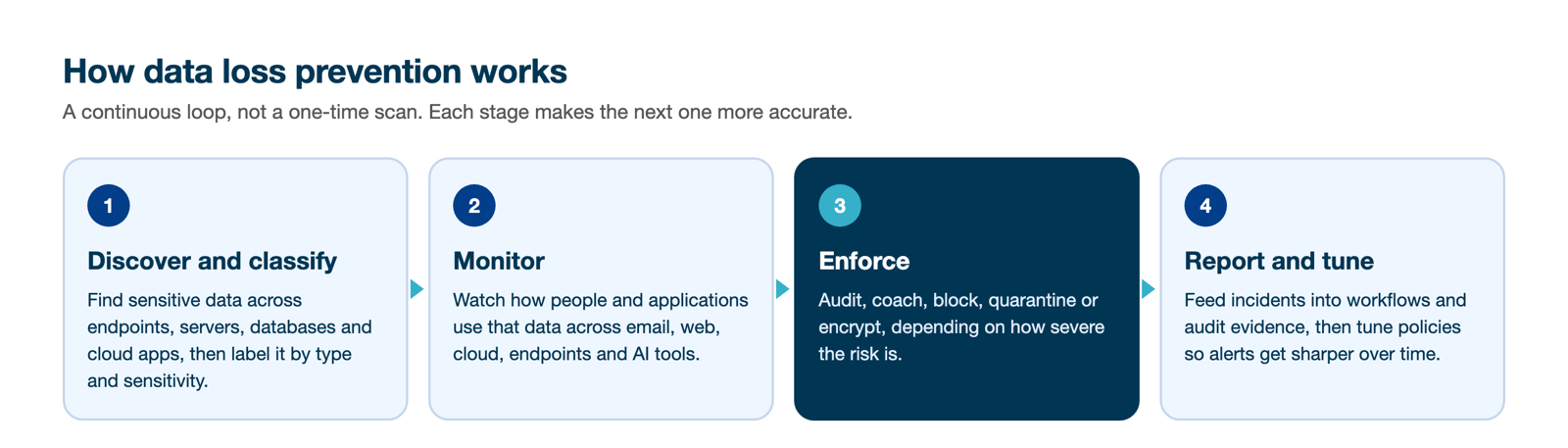
1- Discover and classify. The solution scans endpoints, file servers, databases and cloud repositories to build a current inventory of sensitive data, then labels it by type and sensitivity using pattern matching, fingerprinting, exact data match and machine learning.
2- Monitor. It watches how users and applications interact with that data in real time across email, web, cloud apps, endpoints and AI tools, looking for signals that something risky is happening.
3- Enforce. When activity matches a policy, DLP acts. It can audit the event, coach the user, block the transfer, quarantine the file or encrypt the message, depending on how severe the risk is.
4- Report and tune. Every event feeds incident workflows and audit evidence, and the patterns it reveals drive policy tuning, so the program gets more accurate over time instead of noisier.
What separates effective DLP from noisy DLP is the enforcement step. Detection without action isn't protection. The organizations that get the most value from DLP are the ones that connect what they see to what they do, automatically and at the speed data actually moves.
What Causes Data Loss?
Most data loss isn't the result of a sophisticated attack. It's the result of ordinary activity that nobody was watching. The most common causes fall into five groups:
- Human error. An email sent to the wrong recipient, a file shared with anyone who has the link, a spreadsheet uploaded to a personal drive. Most incidents start here, with people who had no intention of causing harm.
- Insider risk. Employees and contractors with legitimate access can take data with them when they leave or move it somewhere they shouldn't. The difference between insider threat and insider risk matters, because most cases come down to negligence rather than malice.
- External attacks. Phishing, credential theft and malware give attackers a foothold, and data exfiltration is usually the goal. AI is making those attacks faster. The IBM Cost of a Data Breach Report 2026 found that one in four malicious breaches were AI-enabled, and those breaches cost an average of $6 million.
- Oversharing and misconfiguration. Overly broad permissions, public cloud storage links and stale access rights leave sensitive data exposed without anyone moving it at all.
- Generative AI tools. Employees paste source code, customer records and contract language into AI prompts to get work done faster, often in tools the security team doesn't know about.
DLP addresses all five, but not in the same way. Human error responds to coaching. Insider risk needs behavioral context. Oversharing needs discovery. That's why the most effective programs combine content inspection with context about who is acting and why.
Why Organizations Invest in DLP
The reasons organizations build DLP programs have expanded significantly over the past few years. What started as a compliance exercise has grown into a core operational requirement. The five drivers below build on each other — understanding how they connect is as important as understanding each one individually.
Regulatory compliance. GDPR, CCPA, HIPAA, PCI-DSS and a growing body of regional data privacy laws require organizations to demonstrate control over sensitive data. Violating these regulations carries serious financial and reputational consequences. Forcepoint DLP includes more than 1,800 pre-defined templates, policies and classifiers covering regulatory requirements of more than 80 countries and 160 regions, dramatically reducing the manual work required to maintain compliance.
Intellectual property protection. Trade secrets, product designs and proprietary research are among the most valuable assets an organization holds. They're also among the most difficult to trace once they have left the building. DLP gives security teams the visibility to track how IP flows and the controls to stop unauthorized transfers before damage is done.
Insider risk mitigation. Not every data loss event is an attack. Employees make mistakes, get careless with sensitive files or take data with them when they leave. Whatever the cause, the stakes are high: the IBM Cost of a Data Breach Report 2026 puts the global average cost of a breach at a record $4.99 million. DLP is one of the most effective tools for detecting risky behavior and intervening before data walks out the door. For a deeper look at this problem, see our Essential Guide to Insider Risk.
Cloud and SaaS governance. As organizations move workloads to Microsoft 365, Google Workspace, Salesforce and dozens of other SaaS platforms, data governance becomes significantly harder. DLP extends visibility and policy enforcement into cloud environments, so the same protections that govern your network also govern your cloud activity.
Generative AI exposure. This driver has moved from an emerging concern to an urgent one. Employees are actively pasting sensitive data into AI tools like ChatGPT, Copilot and a growing list of third-party models. Without DLP controls, there is no way to know what is going into those prompts or what is coming back out. Agentic AI systems compound the problem further: when AI agents can autonomously access, summarize and redistribute data across workflows, the scope of potential exposure grows far beyond what any individual user action could create. DLP helps organizations enable generative AI safely by monitoring and controlling what data enters and exits those applications and by enforcing boundaries that traditional perimeter controls were never designed to address.
Types of DLP: Network, Endpoint and Cloud
Modern organizations need coverage across multiple environments. That means understanding the different types of DLP solutions and where each one addresses risk.
Network DLP
Network DLP monitors and controls data in motion across your network. It inspects traffic at egress points, examining outbound email, web traffic and file transfers for sensitive content before that content leaves the organization. Network DLP is strongest at catching data moving through monitored channels at the perimeter, which makes it a critical first layer for organizations with significant data volumes flowing out through centralized points. See how network DLP compares to endpoint DLP to understand where each provides the strongest coverage.
Endpoint DLP
Endpoint DLP protects data on individual devices, including laptops, desktops and servers. Because endpoint agents operate directly on the device, they enforce controls even when users work off-network. This makes endpoint DLP especially important in hybrid and remote work environments, where a significant share of sensitive data handling happens outside the office. Endpoint DLP covers data in use (copy/paste, printing, screen capture) as well as data in motion at the device level.
Cloud DLP
Cloud DLP secures data as it moves into, out of or within cloud services. Effective cloud DLP requires policies tuned to cloud-native workflows: sharing permissions, SaaS integrations and collaboration patterns that do not exist in traditional network environments. Many organizations deploy cloud DLP as an extension of their network DLP, using integrations with tools like a Cloud Access Security Broker (CASB) to extend policy enforcement to every SaaS application employees use.
In practice, choosing just one type creates blind spots. Network DLP and endpoint DLP are complementary by design and cloud DLP fills the gaps that open up when users move data through SaaS and web applications. Forcepoint DLP unifies policy creation and enforcement across all three, so you manage one consistent policy framework rather than three separate tools.
What to Look for in a DLP Solution
Not all DLP software delivers the same level of protection. As you evaluate options, these are the capabilities that separate effective programs from ones that generate noise without stopping breaches.
- Content detection accuracy. The ability to detect specific types of sensitive data, including PII, PCI, PHI and intellectual property, with high accuracy is the foundation of effective DLP. Look for solutions that use a combination of pattern matching, fingerprinting and machine learning to identify sensitive content in context, not just by keyword. Forcepoint DLP includes more than 1,800 pre-defined classifiers, along with exact data match (EDM) and optical character recognition (OCR) capabilities for structured and unstructured data alike.
- Contextual policy enforcement. A policy that fires the same response every time a social security number appears in a file will generate enormous volumes of false positives and quickly lose the confidence of the security team. Strong DLP uses context: who is the user, what device are they on, what is their role, where is the data going? Policies should adapt based on these factors, escalating responses when risk is elevated and reducing friction when behavior is normal.
- User behavior analytics. DLP incidents are rarely random. Risky behavior follows patterns. The ability to distinguish an honest mistake from intentional exfiltration requires more than content inspection. User behavior analytics (UBA) gives security teams the context to understand the intent behind a data interaction, not just the content.
- Unified policy management. Managing separate policy stacks for endpoints, network and cloud creates inconsistencies and increases management overhead. The best DLP solutions enforce consistent policies across all channels from a single console, reducing the chance that a gap in one environment becomes an incident.
- Deployment flexibility. Organizations have different infrastructure realities. Look for a DLP solution that can be deployed in the cloud (SaaS) or on-premises, and that integrates cleanly with your existing IAM, SIEM and SOAR platforms.
- Compliance coverage. Pre-built templates for major regulatory frameworks dramatically reduce the time required to configure compliant policies. For guidance on evaluating specific vendors, see our comparison of the best DLP software in 2026.
How to Choose a DLP Solution for IT Operations and GRC Teams
IT operations needs policies it can deploy, tune and run without breaking workflows. GRC needs controls mapped to regulations and evidence for auditors. Choose one policy engine that serves both. Forcepoint DLP enforces a single policy across endpoint, network, cloud, email and web, and GRC teams start from more than 1,800 pre-defined templates, policies and classifiers covering more than 80 countries and 160 regions.
Building and Enforcing DLP Policies
DLP policies are the rules that tell your solution what to protect, how to detect it and what to do when a policy condition is met. Getting them right is harder than most teams expect. Getting them wrong is one of the most common reasons DLP programs stall.
The strategic side of policy design starts with clarity about what you are actually trying to protect. That means defining your sensitive data categories clearly, mapping the channels where that data is most likely to move and prioritizing the scenarios that carry the most risk. Organizations that try to write policies for every conceivable data type from day one typically end up with an unmanageable rule set and a false-positive rate that erodes confidence in the program.
On the operational side, effective policy enforcement requires thinking about what happens when a policy fires. A block without explanation creates friction and user frustration. A warning with in-line coaching turns a policy collision into a learning moment. The most mature DLP programs use a combination of hard blocks for high-risk scenarios and educational prompts for lower-risk ones, tuning those responses over time based on observed behavior.
Policy maintenance is also not a one-time project. As your organization adds new cloud applications, onboards new AI tools or enters new regulatory jurisdictions, your policy set needs to evolve alongside those changes. Classification standards shift. Data types that were low-risk last year may carry regulatory weight today. A DLP policy framework that is not actively managed will drift out of alignment with your actual risk profile.
For a deeper look at what good policy design looks like in practice, including step-by-step guidance on building and enforcing DLP policies that scale, see our dedicated post on DLP policies.
DLP Security: Closing the Visibility-to-Control Gap
DLP security used to be a simpler problem. Data lived in known places, moved at human speed and security teams had enough time to classify it, label it and write static policies around it. That world is gone.
Today, data is created and reshaped continuously by AI models, agents and automated workflows. It spreads across SaaS platforms, endpoints and cloud environments before security teams can track it. The result is a widening gap between visibility and control: organizations can sometimes see risk, but they cannot always act on it quickly enough to matter. That gap is where breaches happen.
Closing the visibility-to-control gap requires security that is context-aware, adaptive and continuous. It means connecting what you can see to what you can do and doing that fast enough to stay relevant. It means DLP that does not just detect policy violations but understands the context behind them: who triggered the event, what their risk profile looks like, how the data involved is classified and what the right response is given all of those factors together.
This is why DLP has become a foundational element of a broader self-aware approach to data security, one that does not separate discovery from enforcement but unifies both in a continuous loop.
DLP for AI: Securing Sensitive Data in Generative Tools
Generative AI has introduced a fundamentally new data exposure surface. Employees using ChatGPT, Microsoft Copilot, Google Gemini and a rapidly expanding list of third-party AI tools can paste entire documents, spreadsheets and code repositories into a prompt without ever triggering a traditional DLP alert. Agentic AI systems compound this further: when an AI agent can autonomously retrieve files, summarize content and push outputs into downstream workflows, sensitive data can travel further and faster than any individual user action could cause.
DLP for AI closes this gap by extending the same inspection and enforcement capabilities that govern email and endpoint activity to AI application interfaces. Policies can block sensitive data from entering a generative AI prompt, flag outputs that contain regulated content and log all interactions for audit purposes. Organizations with mature DLP programs typically integrate AI tool governance into their existing policy framework rather than building separate controls, ensuring that the rules governing data in every other channel also apply to AI.
The scope of DLP for AI extends beyond what employees intentionally share. Mislabeled or unclassified data that a copilot can access is just as exposed as data a user pastes manually. That is why DLP for AI works best when paired with Data Security Posture Management (DSPM), which ensures data is correctly discovered and classified before AI tools can reach it. For a deeper look at how Forcepoint addresses this challenge, see our guide on securing sensitive data in the age of AI.
DLP and the Broader Data Security Ecosystem
DLP does not operate in isolation. It is most effective when it works in concert with complementary data security tools.
Data Security Posture Management (DSPM) focuses on data at rest, discovering what sensitive data exists, where it lives and whether access permissions are appropriate. DSPM answers the questions that precede DLP: What data do we have? Where is it stored? Who can reach it? Those answers make DLP policies far more accurate, because policies built on accurate data classifications generate fewer false positives and miss fewer real incidents.
Data Detection and Response (DDR) focuses on data in use, providing continuous monitoring and dynamic response capabilities that detect and contain threats as they develop. Together, DSPM, DDR and DLP address all three states of data, creating a unified approach to protection that covers data wherever it lives, however it is accessed and however it changes over time.
DLP is also often confused with endpoint detection and response (EDR). EDR watches devices for malicious activity, such as malware, suspicious processes and attacker behavior, and helps contain threats on the endpoint. DLP watches the data itself. EDR asks whether a device has been compromised. DLP asks whether sensitive data is going somewhere it shouldn't. Most mature security programs run both.
Copilots and AI agents add a new dimension. A copilot with access to unclassified or mislabeled sensitive data can surface regulated content in response to a routine query. DSPM makes sure data is correctly classified before copilots can reach it, while DLP controls what they can retrieve and output. For more on how these capabilities reinforce each other, see how DLP, DSPM and DDR work together.
For organizations managing data across Microsoft 365, this integration is particularly valuable. Forcepoint helps organizations protect data in Microsoft 365 and Copilot, including SharePoint, OneDrive, Teams and Exchange, with unified data security controls that follow data across every surface where it can appear. For a detailed look at what that coverage includes, see our post on extending DLP controls to eliminate blind spots.
DLP and Regulatory Compliance
For many organizations, compliance is the catalyst for building a DLP program. Navigating data privacy compliance is complex, but DLP significantly reduces the manual burden by automating policy enforcement and generating the audit evidence regulators require.
Forcepoint DLP supports compliance with major frameworks including GDPR, CCPA, HIPAA and PCI-DSS. Out-of-the-box policy templates let security teams configure compliant policies in minutes rather than weeks. For organizations operating across multiple jurisdictions, templates covering more than 80 countries and 160 regions mean compliance coverage scales with the business rather than lagging behind it.
VakifBank, Turkey's second-largest bank, shows what that looks like in practice. Facing GDPR and KVKK obligations for the personal data of more than 15 million customers, the bank deployed Forcepoint DLP in one month, used fingerprinting to protect nearly 20 million files and blocked 4,000 incidents within the first three months.
The motivation behind moving to Forcepoint was data privacy — GDPR and KVKK being the two big reasons.
Akif Mert Avcı, Information Security Manager, VakifBank
The regulatory landscape is also shifting in ways that affect DLP strategy directly. The EU AI Act introduces new requirements around how organizations govern AI systems and the data that flows through them. State-level privacy laws in the U.S. are proliferating, with requirements that vary by jurisdiction in ways that create real complexity for organizations with national or global operations. DLP programs built on manual classification and periodic audits are not equipped to handle that pace of change. Automated discovery, continuous classification and adaptive policy enforcement are what keep compliance coverage intact as the regulatory environment evolves.
Compliance is not a one-time project. As regulations evolve, as the organization expands into new markets and as data environments grow more complex, DLP must evolve alongside them.
10 Best Practices for a Successful DLP Program
Building an effective DLP program takes more than deploying technology. The organizations that see the most sustained value from DLP follow a disciplined approach from day one. Here's the short version. Our guide to data loss prevention best practices walks through each one in the order it matters.
1- Secure executive sponsorship. DLP touches workflows across the entire organization. Without visible commitment from leadership, adoption and enforcement consistency suffer.
2- Start with discovery. You can't protect what you don't know you have. Run a thorough data discovery scan before writing a single policy. Forcepoint DSPM automates that discovery across cloud and on-premises data, so your first policies are built on what actually exists.
3- Prioritize your crown jewels. Not all data carries equal risk. Classify data by value and regulatory exposure, build your initial policies around the assets that matter most.
4- Use risk-adaptive policies. Static rules generate false positives. Adaptive policies that account for user behavior, role and context reduce noise and improve precision.
5- Roll out in phases. Begin in monitor-only mode to understand your baseline, then move to warn and finally enforce. This approach builds confidence in policies before enforcement begins and reduces the disruption caused by misconfigured rules.
6- Integrate with IAM and SIEM. Identity context and security event correlation accelerate incident response and give analysts the information they need to triage alerts efficiently.
7- Educate users continuously. In-line coaching delivered when a user is about to violate a policy is significantly more effective than annual training. It turns policy collisions into learning moments.
8- Measure and iterate. Track incident reduction rates, false-positive rates and audit pass rates over time. A DLP program that does not improve is not being managed.
9- Automate where possible. Connect DLP to your SOAR platform, ticketing system and auto-remediation workflows to reduce the manual burden on security teams and accelerate response.
10- Plan for generative AI. Define and enforce policies for how sensitive data interacts with tools like ChatGPT, Copilot and other AI platforms. The organizations that do this now will avoid the compliance and reputational exposure that comes from unmanaged AI data flows.
How to Deploy Forcepoint DLP: A Practical Timeline
Every deployment is different, but Forcepoint professional services has supported many successful DLP SaaS deployments in as few as six weeks. Here's a realistic framework for planning your rollout.
| Phase | Suggested Timeline |
|---|---|
| Scope and Project Initiation | Weeks 1–2 |
| Review Current Environment | Weeks 2–4 |
| Installation and Configuration | Weeks 3–4 |
| Phased Deployment | Weeks 4–5 |
| Monitoring and Testing | Weeks 4–6 |
| Knowledge Transfer | Weeks 5–6 |
Forcepoint DLP deploys in the cloud (SaaS) or on-premises and integrates with existing IT infrastructure including IAM, SIEM and endpoint management tools.
A well-planned rollout pays off quickly. After its previous DLP tool left gaps through disparate policies, Tata Consultancy Services moved to Forcepoint DLP, started its data loss prevention project 50–70% faster than expected and reported seeing value from its investment within three to six months.
How to Measure DLP Success
A DLP program without metrics is a DLP program that cannot improve. These are the key performance indicators that signal whether your program is working.
- Incident reduction rate. Track the total volume of data exfiltration attempts blocked across email, cloud apps and endpoints over time. A declining trend indicates policies are working. A flat or rising trend is a signal to investigate.
- False-positive rate. High false-positive rates erode user trust and cause security teams to tune down policies rather than fix them. Track this metric closely, especially in the first 90 days after rollout.
- Compliance audit performance. Measure audit preparation time and pass rates before and after DLP deployment. Organizations using pre-built compliance templates consistently reduce audit preparation time and associated costs.
- Policy coverage gaps. Regularly review which data types and channels are covered by active policies and which are not. Coverage gaps are risk gaps.
Frequently Asked Questions
Does DLP slow down productivity?
The concern is understandable, but modern DLP, deployed thoughtfully, actually improves operational efficiency. By consolidating policy management across endpoints, networks and cloud applications into a single framework, teams spend less time managing duplicate rules and more time on meaningful security work. Risk-adaptive enforcement further reduces friction by calibrating controls to actual user behavior rather than applying maximum restriction universally.
What is DLP security?
DLP security refers to the technologies and practices that prevent sensitive data from being accessed, transferred or exposed in ways that violate policy. DLP security covers the full lifecycle of data movement: discovery and classification, real-time monitoring and enforcement when a policy condition is triggered. It is a core component of any mature cybersecurity strategy.
Which organizations need DLP?
Any organization that handles PII, PHI, PCI, intellectual property or regulated data of any kind needs DLP. Organizations operating in BYOD environments, with remote or hybrid workforces, or with significant cloud footprints have elevated exposure. DLP is not exclusively a large-enterprise requirement. It scales to meet the needs of organizations at every size.
What is the difference between DLP and DSPM?
DSPM and DLP solve different parts of the same problem. DSPM discovers and classifies sensitive data at rest and checks whether access to it is appropriate. DLP enforces policies that stop that data from moving in ways that create risk. They work best together, with DSPM providing the classification foundation that makes DLP policies more accurate.
What is the difference between EDR and DLP?
EDR (endpoint detection and response) protects devices. It detects malware, suspicious processes and attacker activity on endpoints and helps contain them. DLP protects data. It identifies sensitive information and stops it from leaving through email, web, cloud apps, endpoints or AI tools. EDR asks whether a device is compromised. DLP asks where sensitive data is going.
How can I prevent data leakage?
Start by discovering and classifying your sensitive data, so you know what needs protecting. Then apply DLP policies across every channel where data moves, including email, web, cloud apps, endpoints and AI tools. Coach users in the moment instead of relying on annual training, and review false positives and coverage gaps regularly.
Can Forcepoint DLP protect data in generative AI tools?
Yes. Forcepoint DLP monitors and controls data inputs and outputs in generative AI applications, preventing sensitive information from being pasted into prompts and blocking confidential outputs from leaving through monitored channels. This extends to agentic AI systems and copilots. For more on this use case, see AI data security.
How does DLP for AI work?
DLP for AI treats prompts and AI outputs as data channels that need the same governance as email or file transfers. Policies can block sensitive data from entering a generative AI prompt, flag outputs that contain regulated content and log interactions for audit. Mature programs fold AI governance into their existing policy framework rather than building separate controls.
How long does a DLP deployment take?
A scoped Forcepoint DLP SaaS deployment can be completed in as few as six weeks. Full enterprise rollouts that include phased policy tuning, IAM and SIEM integration and user education typically run eight to twelve weeks. The fastest deployments start with a clear inventory of sensitive data before rollout begins.
What is a DLP policy?
A DLP policy is a set of rules that tells your DLP system what sensitive data to look for, where to look and what to do when it finds it. For example, a policy might block a file containing Social Security numbers from being uploaded to a personal cloud drive, or warn the user and encrypt it instead.
See the Industry-Leading Forcepoint DLP in Action
Data loss prevention is not a product you deploy and forget. It is a program you build, measure and improve, one that adapts alongside your data environment, your workforce and the threats you face.
Forcepoint DLP delivers unified visibility, adaptive control and automated protection across every critical channel. It's backed by two decades of leadership in data security, and Forcepoint was named a Leader in the IDC MarketScape: Worldwide DLP 2025 Vendor Assessment.
Want to see how it fits your environment? Read the Practical Executive's Guide to DLP or talk to a Forcepoint expert to learn how DLP fits into your broader data security strategy.
See Forcepoint DLP in action
One policy across endpoint, network, cloud, email, web and AI tools, managed from a single console.

Lionel Menchaca
Leer más artículos de Lionel MenchacaLionel Menchaca has covered data security at Forcepoint since 2020, writing about DLP, DSPM, insider risk and AI security for security and IT leaders. He works with Forcepoint X-Labs threat researchers to turn their findings on emerging threats, from AI-targeted supply chain attacks to prompt injection, into practical guidance, and he leads the company's editorial strategy across the blog and the X-Labs newsletter. Before Forcepoint, Lionel founded and ran Dell's corporate blog for seven years and spent two decades helping enterprise tech companies explain security, cloud and AI.
 The Practical Executive's Guide to Data Loss PreventionLeer el Documento Técnico

X-Labs
Reciba información, novedades y análisis directamente en su bandeja de entrada.

Al Grano
Ciberseguridad
Un podcast que cubre las últimas tendencias y temas en el mundo de la ciberseguridad
Escuchar Ahora