Top 10 DSPM Vendors Compared: Choosing the Best DSPM Vendor
0 分鐘閱讀

Tim Herr
Sensitive data has never been harder to control. As organizations expand across multi-cloud environments, SaaS applications and on-premises infrastructure simultaneously, visibility gaps multiply and the risk of a breach grows with them. Traditional data protection tools were not built for this level of complexity or scale.
Data Security Posture Management (DSPM) was created to close that gap. It gives security teams continuous visibility into where sensitive data lives, who can access it, how it moves and where exposure is growing before attackers or auditors find it first. But with a growing field of best DSPM software options competing for your attention, choosing the right vendor requires more than a feature checklist.
This guide compares the top 10 DSPM vendors based on capability depth, hybrid environment support, classification accuracy and integration with broader data security ecosystems. To understand the full scope of what these platforms do and how to evaluate them, see our complete DSPM guide.
This guide is published by Forcepoint. We evaluate our own product against the same criteria as every vendor listed.
Key Takeaways
- Prioritize data discovery across all environments. Most vendors cover cloud only, so hybrid and on-premises deployment flexibility is the real differentiator.
- Insist on accurate, customizable AI classification for structured and unstructured data, or generic classifiers bury real risk in false positives.
- Weigh permissions analysis and least privilege enforcement with built-in remediation, so the vendor acts on risk instead of just reporting it.
- The strongest DSPM vendors integrate with DLP, DDR and your security stack, turning classification into enforcement.
How We Evaluated These DSPM Vendors
To build this list, we researched every DSPM vendor the same way. For each one, we reviewed:
- Public product documentation, including datasheets, technical docs, pricing pages and release notes
- Independent analyst evaluations, such as the IDC MarketScape and the Gartner Market Guide for the category
- Verified user reviews and ratings on G2, PeerSpot and Gartner Peer Insights
- Each vendor's publicly documented integrations, deployment options and platform coverage
We scored every vendor, including Forcepoint, against the same criteria: breadth of coverage across environments, classification accuracy, integration with the wider security stack, deployment flexibility and ease of management. Placement on this list cannot be bought. No vendor paid to be included or ranked.
Capabilities change fast in this market. We review and update this list frequently. This post was last reviewed in July 2026.
Top 10 DSPM Vendors Overview
The table below compares leading data security posture management vendors across the capabilities that matter most for enterprise deployments, using the methodology described above.
Vendors below are listed alphabetically. Yes = fully supported, Partial = partially supported, No = not supported.
| Vendor | AI/ML Classification | On-Prem & Hybrid | File Permissions | Compliance Automation | DLP Labeling | Risk & Breach Impact |
|---|---|---|---|---|---|---|
| BigID | Partial | Yes | Yes | Yes | Partial | Yes |
| Cyera | Partial | Partial | Yes | Yes | Partial | Yes |
| Forcepoint DSPM | Yes | Yes | Yes | Yes | Yes | Partial |
| Microsoft Purview | Partial | Partial | Partial | Partial | Partial | Partial |
| Netskope | No | No | Yes | Partial | No | Partial |
| Palo Alto (Prisma Cloud) | No | No | Yes | Partial | Yes | Partial |
| Rubrik | No | Yes | Yes | Partial | No | Yes |
| Securiti | Partial | Partial | Yes | Yes | Partial | Yes |
| Varonis | Partial | Yes | Yes | Yes | Partial | Yes |
| Zscaler | No | No | Yes | Partial | Partial | Partial |
Ratings reflect Forcepoint's review of public vendor documentation, analyst reports and verified user reviews as of August 2026. Capabilities in this market change quickly. Confirm current functionality directly with each vendor before making a purchase decision.
Forcepoint DSPM
Forcepoint DSPM is best for hybrid and on-premises enterprises that need consistent classification across cloud and on-premises without visibility gaps. It classifies structured and unstructured data across file servers, databases, SharePoint, SaaS platforms and AI workflows from a single platform.
Its AI Mesh classification runs on standard CPUs rather than requiring GPU hardware, which makes on-premises and air-gapped deployment practical for regulated and restricted networks. Because classification tags travel with the data into Forcepoint DLP and DDR, posture management connects directly to enforcement instead of stopping at a report.
Key features:
- AI Mesh classification for structured and unstructured data, on-premises and in the cloud
- CPU-native architecture with support for air-gapped deployment
- File-level permissions visibility with single-click access review
- Built-in remediation for access revocation, quarantine and archival
- ROT data hygiene and compliance automation across GDPR, HIPAA, CCPA and CMMC
- Native DLP and DDR integration, with classification tags that persist across environments
Forcepoint: 4.5 out of 5 (25 ratings), Gartner® Peer Insights
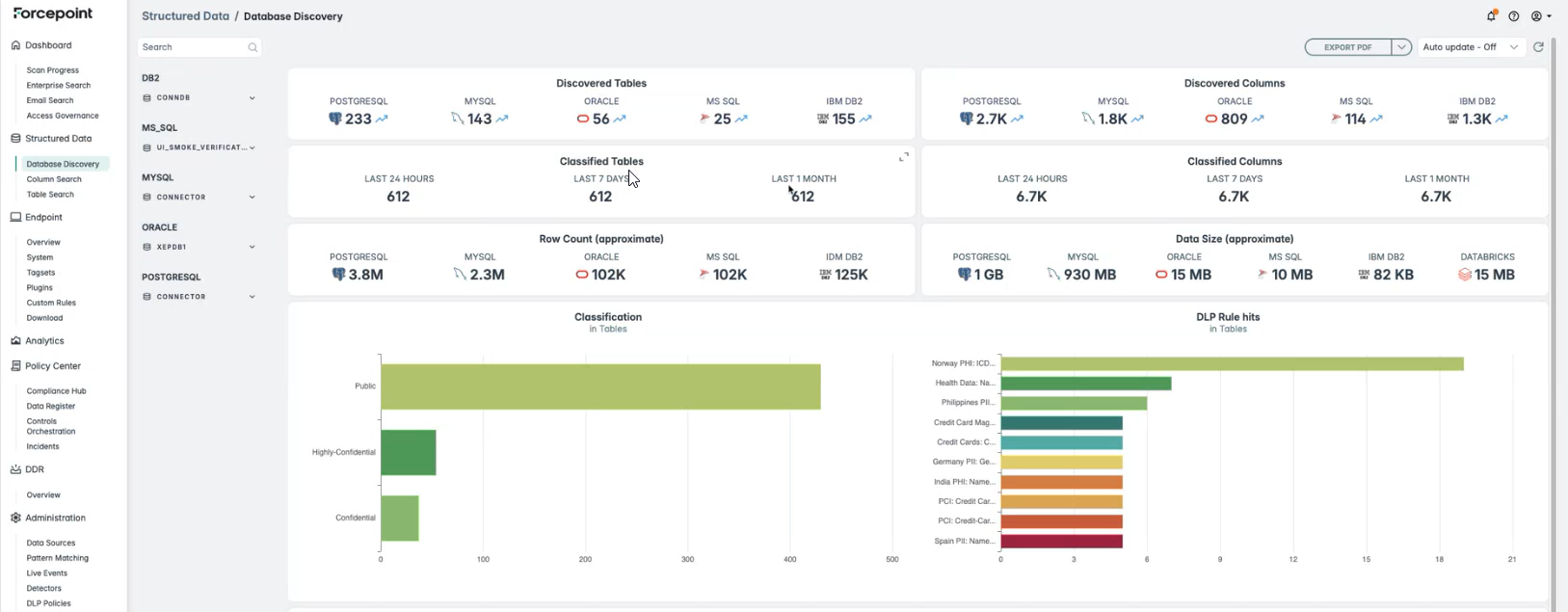
Image credit: Forcepoint
Pros:
- Strong hybrid and on-premises coverage
- AI classification that runs locally without GPU hardware
- Unified with DLP and DDR
Cons:
- Broad platform, so teams wanting a narrow cloud-only point tool may find it more than they need
- Strongest value when paired with Forcepoint DLP and DDR
Best for: Enterprises managing data across hybrid cloud and on-premises, and regulated industries with data residency or air-gap requirements
Varonis
Varonis is best for Microsoft-centric file security, with deep heritage in file-level analysis and Microsoft 365 integration. Its DSPM capabilities focus on unstructured data access governance across SharePoint, OneDrive and on-premises Active Directory, identifying over-permissioned configurations and usage patterns, with strong compliance reporting and data hygiene in those ecosystems.
Note that Varonis has publicly committed to ending support for its legacy self-hosted platform by December 31, 2026, consolidating onto a SaaS-delivered control plane, which matters for cloud-restricted and private-cloud organizations.
Key features:
- Granular file-level permissions analysis across Microsoft 365 and file systems
- Unstructured data hygiene with insight into stale, orphaned and overshared data
- Privacy and compliance automation for regulated collaboration data
- DLP-grade labeling and fingerprinting
- AI and ML classification that augments rule-based policies
Varonis: 4.8 out of 5 (896 ratings), Gartner Peer Insights
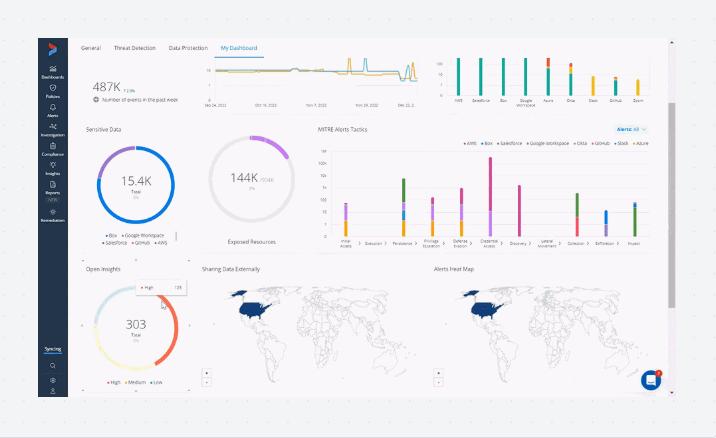
Image credit: Varonis
Pros:
- Strong file-level permissions analysis;
- Mature Microsoft ecosystem support;
- Solid data hygiene
Cons:
- Classification customization is limited
- SaaS-only roadmap creates risk for hybrid and cloud-restricted organizations
Best for: Enterprises that prioritize Microsoft 365 and file-share security and can accommodate a SaaS delivery model
BigID
BigID is best for privacy-driven governance programs that need discovery and cataloging across large, complex data estates. It pairs data discovery and classification with consent management, data rights workflows and governance automation, and excels at classifying data across mainframes, data lakes and complex structured environments.
Visual data maps help compliance and legal stakeholders trace sensitive data through pipelines, and BigID recently expanded into AI governance to track model training data. Remediation tends toward ticketing workflows rather than automated policy enforcement, which can slow response on high-priority exposures.
Key features:
- Broad discovery and cataloging across structured and unstructured sources
- Consent management and DSAR workflows for privacy programs
- Visual data maps for tracing sensitive data through pipelines
- AI governance for model training data
- Governance automation with rich metadata
BigID: 4.6 out of 5 (81 reviews), Gartner Peer Insights
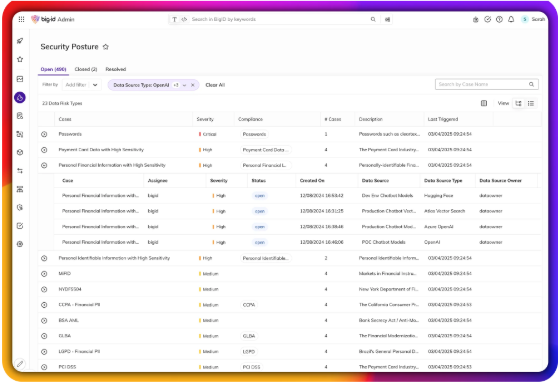
Image credit: BigID
Pros:
- Strong privacy compliance toolset
- Good structured data coverage
- Mature DSAR workflows
Cons:
- Remediation is workflow-based rather than automated
- Classification customization is partial
Best for: Organizations with heavy privacy compliance requirements managing DSAR workflows or complex regulatory obligations.
Securiti
Securiti is best for unified data and AI governance, combining DSPM with privacy intelligence and AI governance. It maps sensitive data across hybrid and multi-cloud environments with strong compliance reporting and DSAR automation, and pairs posture management with privacy operations in a single platform.
On-premises coverage is partial compared to its cloud capabilities, which limits its value for organizations with significant legacy infrastructure.
Key features:
- Sensitive data mapping across hybrid and multi-cloud environments
- Privacy intelligence and DSAR automation
- AI governance capabilities
- Strong compliance reporting
- Embedded privacy operations workflows
Securiti: 4.7 out of 5 (52 ratings), Gartner Peer Insights
Pros:
- Strong compliance reporting
- AI governance capabilities
- Broad cloud coverage
Cons:
- Partial on-premises support
- Limited classification customization
Best for: Enterprises seeking a unified data and AI governance platform with embedded privacy operations.
Cyera
Cyera is best for cloud-native discovery speed, an agentless platform built for rapid time to value across the major cloud providers and SaaS applications. Its privacy automation is strong for regulated cloud deployments, and it has expanded to monitor AI model training data and data lineage.
Cyera only partially supports on-premises environments, requiring on-prem connectors and proxies, so organizations with significant legacy infrastructure may need to supplement it.
Key features:
- Agentless, cloud-native discovery and classification
- Fast time to value across major clouds and SaaS
- Sensitive data mapping and access analysis
- Privacy automation for regulated cloud deployments
- Monitoring of AI model training data and lineage
Cyera: 4.6 out of 5 (335 ratings), Gartner Peer Insights
Pros:
- Fast deployment
- Strong cloud and SaaS coverage
- Good privacy automation
Cons:
- No on-premises support
- Limited classification customization
Best for: Cloud-first organizations with no on-premises footprint that need fast, broad visibility across cloud platforms.
Rubrik
Rubrik is best for combining backup with data posture, offering a joined view of data risk and recovery readiness. Building on its backup footprint, it discovers and classifies sensitive data and surfaces risky duplicate data, and it supports hybrid deployments following its acquisition of Laminar.
Classification AI is not customizable and DLP-grade labeling is not supported, so teams that need those will look elsewhere.
Key features:
- Discovery and classification built on backup snapshots
- ROT and risky-duplicate data identification
- Combined view of data risk and recovery readiness
- Hybrid deployment support
- Ransomware and data-risk insights from backup telemetry
Rubrik: 4.4 out of 5 (42 reviews), Gartner Peer Insights
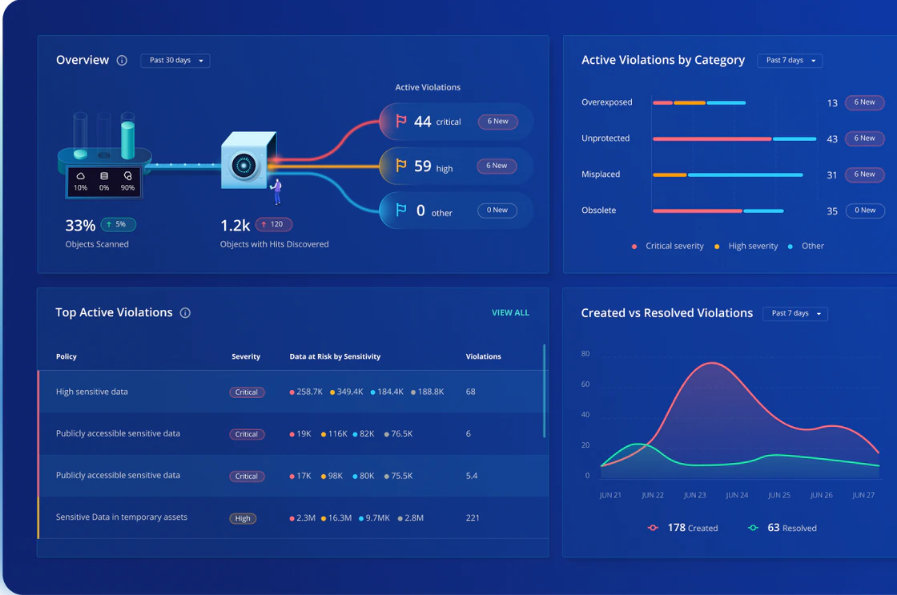
Image credit: Rubrik
Pros:
- Combines backup and posture management
- Solid ROT hygiene
- Hybrid support
Cons:
- Classification AI is not customizable
- No DLP-grade labeling
Best for: Organizations that want to consolidate backup and recovery with data posture management.
Palo Alto Networks (Prisma Cloud)
Palo Alto Networks is best for CNAPP-integrated posture, having embedded DSPM into Prisma Cloud after its 2023 acquisition of Dig Security. It gives a data-layer view within its broader cloud-native application protection platform and correlates data risk with workloads and identities, which is most valuable for organizations already standardized on Prisma Cloud. On-premises environments are not supported and classification AI is not customizable.
Key features:
- Data-layer visibility within a broader CNAPP
- Multi-cloud coverage for workloads, infrastructure and data
- Correlation of data risk with identities and workloads
- DLP labeling support
- Policy-driven guardrails for cloud-native teams
Palo Alto (Prisma Cloud): 4.5 out of 5 (251 ratings), Gartner Peer Insights
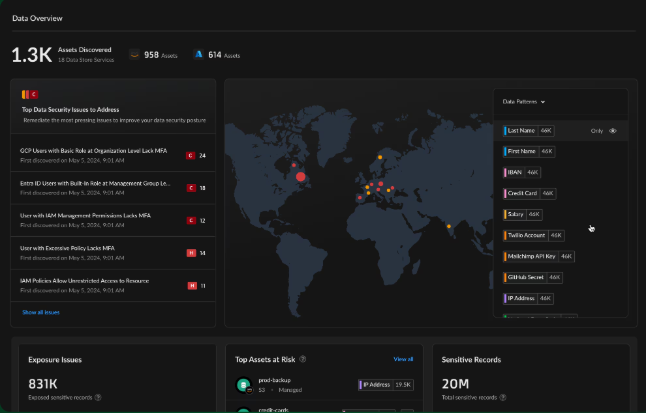
Image credit: Palo Alto Networks
Pros:
- Tight integration with Prisma Cloud
- Good multi-cloud coverage
- DLP labeling support
Cons:
- No on-premises support
- DSPM is a secondary feature within a broader CNAPP
Best for: Enterprises already running Prisma Cloud that want to extend posture management to the data layer.
Zscaler
Zscaler is best for organizations already on the Zscaler platform, offering DSPM capabilities focused on cloud environments as part of its broader security platform. It provides access visibility and basic data hygiene insights, tying data discovery to user and app context. On-premises support is absent and classification AI is not customizable, so it functions as a supplementary capability rather than a purpose-built DSPM.
Key features:
- DSPM tied to the Zscaler SSE and zero trust platform
- Access visibility for cloud environments
- Data discovery linked to user and app context
- Basic data hygiene insights
- Unified policy across data in motion and at rest
Zscaler: 4.5 out of 5 (74 ratings), Gartner Peer Insights
Pros:
- Convenient for existing Zscaler customers
- Access visibility for cloud environments
Cons:
- No on-premises support
- No classification customization
Best for: Organizations standardized on Zscaler wanting basic data posture capabilities without a separate vendor.
Netskope
Netskope is best for SaaS security teams extending into data posture, integrating DSPM into its cloud security suite for organizations already relying on it for SaaS and cloud security. It focuses on data stored in SaaS applications and cloud storage and ties DSPM findings to inline policy enforcement. On-premises environments are unsupported, and both classification customization and DLP-grade labeling are absent.
Key features:
- DSPM integrated with CASB and SSE
- Visibility into data in popular SaaS and collaboration tools
- Inline policy enforcement for sharing, download and access
- Findings linked to real-time controls
- Single-platform management for SaaS-centric teams
Netskope: 4.5 out of 5 (622 ratings), Gartner Peer Insights
Pros:
- Convenient for existing Netskope customers
- Solid SaaS visibility
Cons:
- No on-premises support
- No classification customization
Best for: Organizations invested in the Netskope ecosystem seeking supplementary data visibility.
Microsoft Purview
Microsoft Purview is best for Microsoft-only data estates, providing unified visibility into data across Microsoft 365 and Azure with expanding multi-cloud connectors for AWS and Google Cloud.
Classification is label-driven and leverages Microsoft identity and access controls, which suits organizations standardized on the Microsoft stack. Capabilities are partially supported across most evaluation criteria, and organizations with significant on-premises, non-Microsoft or multi-cloud environments will encounter coverage gaps.
Key features:
- Deep integration with M365, SharePoint, OneDrive and Azure
- Label-driven classification and policy enforcement
- Governance and compliance tied to Microsoft identity
- Expanding multi-cloud connectors for AWS and Google Cloud
- Broad framework coverage within the Microsoft ecosystem
Microsoft Purview: 4.3 out of 5 (29 ratings), Gartner Peer Insights
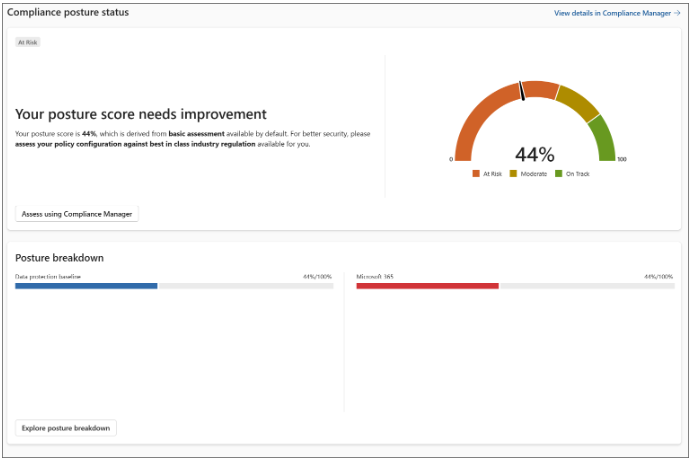
Image credit: Microsoft
Pros:
- Native Microsoft integration
- Broad framework coverage within the Microsoft ecosystem
- No extra vendor for Microsoft-centric shops
Cons:
- Partially supported across all evaluation criteria
- Significant gaps for non-Microsoft and on-premises environments
Best for: Organizations with heavily Microsoft-centric data estates that want native governance within their existing investment.
AI-Powered DSPM vs DSPM for AI: Two Different Problems
These terms get used interchangeably, and answering the wrong one is how tools miss the mark.
- AI-powered DSPM is about using AI to do DSPM better, applying accurate data classification for AI to structured and unstructured content and cutting the false positives that bury real risk. Forcepoint's AI Mesh classification architecture is built for this, learning from your business to classify with minimal configuration. Learn how it works in the AI Mesh overview.
- DSPM for AI is about protecting the data that AI systems touch: finding overexposed files before a copilot can surface them, and keeping sensitive data out of prompts, RAG sources and training sets. See DSPM for AI for the full approach.
A mature program needs both, because accurate classification is what makes AI governance downstream precise rather than generic.
Identifying Breach Impact Quickly
When an incident hits, the question is not only what happened but which sensitive data was affected and who could reach it. Forcepoint DSPM answers this by correlating classification with access and exposure: risk scoring and financial-impact estimates rank the most exposed data, the ransomware exposure analysis dashboard shows where sensitive data sits in harm's way, and pairing DSPM with DDR adds near real-time monitoring and file lineage so teams can scope impact as events unfold.
6 Key Features to Look for in a DSPM Vendor
Not all DSPM solutions deliver equal value. The features below determine whether a platform will reduce real risk or simply generate reports. For a deeper dive on the selection process, see our guide on choosing a DSPM solution.
Data discovery across all environments
A DSPM platform must find sensitive data wherever it lives: cloud object storage, relational databases, SaaS platforms, on-premises file shares, data warehouses and AI pipelines. On-premises coverage should extend to both structured data — databases, data warehouses and structured repositories — and unstructured data, including documents, emails and file shares, simultaneously. Several vendors that technically support on-premises limit their scope to one or the other, which creates blind spots in legacy environments where the most sensitive intellectual property and regulated data often reside.
Discovery should also be continuous rather than point-in-time. An organization that scans quarterly has no visibility into the sensitive data created, moved or duplicated in the intervening months. Continuous discovery ensures that new data stores, shadow copies and over-permissioned files surface automatically. Equally important: confirm whether the vendor charges per discovery scan. Some vendors meter every scan, which creates cost friction that discourages the frequency needed for meaningful posture management. Forcepoint does not charge for additional discovery scans.
Accurate, customizable AI classification
Discovery without accurate classification produces noise, not insight. When a DSPM platform flags thousands of files as sensitive, security teams cannot prioritize effectively. Enterprise-grade platforms combine AI and machine learning to classify structured and unstructured data with high fidelity, including data that lacks obvious keywords, follows proprietary formats or carries industry-specific context that generic pattern matching misses entirely.
The critical distinction is whether classification models are customizable and whether they improve over time. Generic, one-size-fits-all classifiers produce false positive rates that bury real risk in alert fatigue. AI-native platforms that can spin up organization-specific models, trained on the customer's own data patterns, file types and terminology, deliver dramatically better accuracy. A healthcare organization's sensitive data looks different from a defense contractor's, and classification should reflect that.
Hybrid and on-premises deployment flexibility
Many enterprise organizations operate hybrid environments where critical data lives on-premises alongside cloud and SaaS deployments, and some cannot move sensitive data to public cloud infrastructure at all. A DSPM vendor that covers only cloud environments leaves those organizations without posture management for their most sensitive data.
When evaluating hybrid support, look beyond whether the vendor technically connects to on-premises environments. Ask whether the classification engine runs locally, what happens to data in transit during scanning and whether fully air-gapped deployment is supported. Also confirm whether the vendor's AI classification requires GPU infrastructure to operate on-premises, since a platform that requires GPU hardware is effectively cloud-only in practice, regardless of what its documentation says.
Permissions analysis and least privilege enforcement
Knowing where sensitive data lives is only half the picture. Understanding who can access it, and whether that access is appropriate, is equally critical to data access governance. DSPM solutions should provide granular, file-level visibility into permissions across the organization, identifying users and groups with access they no longer need, files shared externally with no expiration, and configurations that violate least privilege principles.
This capability is especially important in environments where permissions are rarely revoked once granted. The strongest platforms allow remediation directly from the DSPM interface, revoking access, quarantining files or adjusting permissions, without requiring a handoff to a separate tool or ticketing queue.
Built-in remediation workflows
A DSPM platform that identifies risk but cannot act on it creates reporting overhead rather than security improvement. Evaluate whether remediation is native or outsourced to ticketing systems, and how much manual intervention stands between a finding and a fix. Native remediation capabilities, access revocation, file quarantine, archival of ROT data and automated policy enforcement, close the gap between discovery and protection without delays.
Integration with DLP, DDR and your security stack
DSPM operating in isolation produces visibility. DSPM integrated with enforcement produces security. The most valuable deployments are those where DSPM classification data feeds directly into DLP policies for data-in-motion enforcement, DDR monitoring for real-time behavioral detection and CASB controls for cloud application governance. Confirm whether integration is native within the same platform or dependent on APIs between separate products, and verify that classification tags persist when data moves across environment boundaries.
Why Organizations Need to Implement Data Security Posture Management
According to IDC, 80% of data globally is unstructured and 90% of that data is never analyzed, leaving organizations largely blind to what sensitive information they hold, where it lives and who can access it. DSPM addresses this directly by providing continuous, automated visibility across the entire data landscape.
What is a DSPM vendor, and how does it differ from a DLP vendor? Data Loss Prevention (DLP) is a mature, policy-driven technology focused on data in motion. It monitors data flowing across email, endpoints, web channels and cloud applications, and blocks or encrypts transfers that violate security policies. DSPM asks a different question: where does sensitive data exist right now, who can access it, and is it properly protected? DSPM is visibility-first and data-at-rest centric. Used together, DSPM provides the context and inventory; DLP turns that insight into active enforcement across every channel employees use.
How does DSPM differ from CSPM? Cloud Security Posture Management (CSPM) secures cloud infrastructure configurations. It identifies misconfigured storage buckets, overly permissive IAM policies, open network ports and compliance drift at the infrastructure level. CSPM can tell you that an S3 bucket is publicly accessible, but not whether that bucket contains sensitive customer records. DSPM fills that gap by looking inside the data stores rather than at their configuration.
Three specific pressures are making DSPM essential for organizations right now. First, data sprawl is accelerating; 94% of organizations store data across multiple cloud environments, and most retain significant on-premises data stores that are never fully inventoried. Second, AI adoption is introducing new risk pathways as tools like Microsoft Copilot and ChatGPT Enterprise access organizational data on behalf of users, often without security visibility into what data those tools touch or generate. Third, global compliance mandates including GDPR, HIPAA, CCPA and CMMC now require organizations to demonstrate continuous compliance readiness, showing they know where regulated data lives and how it is protected. For more on governing AI-related data risk, see DSPM for AI.
How Forcepoint Customers Put DSPM to Work
The following are Forcepoint customer deployments, included to show what DSPM looks like in practice across different industries and requirements.
Financial services, GDPR compliance
FBD Insurance, one of Ireland's largest insurers, deployed Forcepoint DSPM and DDR to discover and classify sensitive policyholder data across a distributed environment and to produce audit-ready GDPR reporting. The security team reported reduced alert fatigue and faster response by prioritizing high-risk incidents.
Manufacturing, hybrid cloud and on-premises
A global food and beverage manufacturer operating in more than forty countries used Forcepoint DSPM and DLP to get unified visibility across cloud and on-premises data while managing rising data volumes and new AI-adoption risk. After a competitive evaluation, the company chose Forcepoint and expanded the deployment from 500 to 1,300 users.
Aerospace, a lean team under AI pressure
A global aviation and aerospace firm used Forcepoint DLP with AI-powered classification and Risk-Adaptive Protection to govern unstructured data and enable safe AI adoption with a three-person security team.
Governing AI data access
Liberty University worked to gain visibility into shadow AI usage and how third-party vendors embed AI into their software, adapting its vendor risk assessment to evaluate AI-data interactions. Brian Johnson, Director of IT Security, framed awareness and visibility as the foundation of the approach.
What to Consider When Choosing a DSPM Vendor for Your Organization
- Data environment coverage. Does the solution cover all your data domains, including cloud, on-premises, SaaS, databases and email? Many DSPM vendors cover cloud only. Confirm that coverage extends to both structured and unstructured data.
- Deployment model. Is an agentless solution preferred, or does your environment require agent-based coverage for endpoints and legacy systems? Confirm whether the vendor supports on-premises or air-gapped deployment.
- Classification feature set. Does the platform offer AI-driven classification that is customizable to your specific data types? Can models adapt to your organization's unique data patterns over time?
- Context and integration. Does the solution connect data risk to identity, access and other security findings? Does it integrate natively with your DLP, DDR, SIEM, SOAR and IAM tools?
- Remediation depth. Can the platform automate remediation natively, or does every fix require a manual handoff to a separate ticketing system?
- Scanning cost structure. Some vendors charge per discovery scan, which creates cost friction that discourages the scanning frequency needed for meaningful posture management.
- Compliance framework coverage. Confirm the platform maps to the specific frameworks your organization is subject to and can generate audit-ready evidence on demand.
How to choose the right DSPM
Choosing the right DSPM depends on where your sensitive data lives and what you need to do with the findings. Cloud-first teams that want fast time to value are well served by cloud-native platforms.
Organizations with hybrid or on-premises systems, or data residency and air-gap requirements, should prioritize vendors that classify on-premises and offer local or air-gapped deployment. Teams focused on acting on risk should weigh how tightly classification connects to DLP, DDR and permissions remediation.
Forcepoint DSPM sits at the hybrid and on-premises end of that spectrum, with on-premises and air-gapped classification and native DLP and DDR integration, and is recognized in the Gartner Market Guide for DSPM and named a Leader in the IDC MarketScape: Worldwide DLP 2025 Vendor Assessment. To see how your own data posture looks today, book a demo.

Tim Herr
閱讀更多文章 Tim HerrTim Herr writes about data security at Forcepoint, where he has covered DSPM, DLP and AI governance since 2023. Before Forcepoint, Tim wrote about Apple device management and security at Jamf and about regulatory compliance for medical device manufacturers at Emergo by UL. He holds a Master of Science in Information Studies from the University of Texas at Austin and is certified in AI Fluency (Anthropic) and Content Marketing (HubSpot).
 Executive Guide to DSPM: Visibility and Control over Sensitive DataRead the eBook

X-Labs
直接將洞察力、分析與新聞發送到您的收件箱