How the Leading Agentic AI Security Solutions Compare
0 minutes de lecture

Lionel Menchaca
Quick answer: The best AI security software for monitoring AI agent activity across an enterprise does three things. It ties every agent action to the agent and the human who triggered it, it finds shadow agents as well as sanctioned ones, and it can pause or block an action as it happens. Forcepoint AI Data Security logs agent identity, triggering user, data accessed, action and timestamp across Claude, Microsoft 365 Copilot, ChatGPT and AWS Bedrock, and AI Agent Gateway holds write and delete actions for human approval.
Autonomous AI agents are already reading email, querying databases and calling business applications inside most enterprises, often with no human reviewing the individual step. A recent Cloud Security Alliance survey found that 68 percent of organizations cannot reliably tell the difference between an action taken by an AI agent and one taken by a person, even as 73 percent expect agents to become essential to their operations within the next year. That gap between adoption speed and control maturity is what agentic AI security solutions exist to close.
This guide compares the leading platforms securing autonomous AI agents in 2026, organized by where each one places its controls: at the identity an agent holds, at the actions it takes in real time or at the data it actually touches. For a deeper look at the specific controls that matter most, see our guide to agentic AI security controls and our agentic AI security best practices. For the broader AI security vendor field beyond agents specifically, see our comparison of top AI security solutions.
This guide is published by Forcepoint. We evaluate our own product against the same criteria as every other vendor listed, and placement cannot be bought.
A note on methodology: Agentic AI security is a new enough category that peer-review platforms such as Gartner Peer Insights and G2 do not yet carry meaningful rating volume for most of the vendors below. Rather than cite thin or unrepresentative review counts, this guide draws on public product documentation, vendor-published technical materials, analyst commentary where it exists and each platform's documented capabilities. We will add independent rating data as the category matures and review volume becomes statistically meaningful.
Key Takeaways
- Agentic AI security splits into three control points that most vendors specialize in: the identity and permissions an agent holds, the behavior an agent exhibits at runtime and the data an agent actually reaches. Few platforms cover all three.
- Identity governance and runtime protection are the two approaches most of the market has consolidated around. Almost none of the current field inspects what happens at the moment an agent touches sensitive data itself.
- Credential brokering matters more than most buyers initially weigh it. An agent that never holds direct application credentials cannot become a standing compromised credential if the agent is manipulated or hijacked.
- Human-in-the-loop approval for high-risk actions, like a write or delete against a business application, closes a gap that pure monitoring tools leave open.
How We Evaluated These Agentic AI Security Solutions
Every vendor below was assessed against the same four criteria:
- Data-layer enforcement. Does the platform inspect and control what an agent reads, aggregates or transmits at the level of the actual data, not just the identity or the API call?
- Identity and access governance. Does it discover agent identities, enforce least privilege and support just-in-time access rather than standing permissions?
- Runtime behavior monitoring. Does it inspect agent actions as they happen and flag or block anomalous behavior?
- Platform fit. How cleanly does the platform integrate with the identity, cloud and security stack an enterprise already runs?
No vendor covers all four equally well today. The comparison below shows where each platform's strength actually sits.
Agentic AI Security Solutions Comparison
| Vendor | Category | Primary Control Point | Best For |
|---|---|---|---|
| Forcepoint AI Data Security | Enterprise Platform Data-Layer Control | Sensitive data agents touch | Orgs extending existing DLP/DSPM policy to agents |
| Linx Security | Identity & Access Governance | Identity graph & inline enforcement | Unified human, non-human & agent identity |
| Astrix Security (Cisco) | Identity & Access Governance | Non-human identity & entitlements | Purpose-built non-human/agent discovery |
| Entro Security (SailPoint) | Identity & Access Governance | Secrets & agent identity | Governing agents alongside exposed secrets |
| Oasis Security | Identity & Access Governance | Just-in-time access | Pre-action, intent-based agent access |
| Zenity | Runtime Behavior & Posture | Step-level execution monitoring | Visibility into agent behavior in production |
| Lakera (Check Point) | Runtime Behavior & Posture | Prompt-level guardrails | Blocking prompt injection & jailbreaks |
| Palo Alto Networks (Prisma AIRS) | Enterprise Platform | Multi-layer, consolidated | Existing Palo Alto platform customers |
| Microsoft (Entra Agent ID) | Enterprise Platform | Directory-native agent identity | Microsoft-centric environments |
| CrowdStrike | Enterprise Platform | Unified identity threat detection | Existing Falcon platform customers |
Data-Layer Control
This category asks a different question than the rest of the field. Instead of “what can this agent reach” or “is this agent behaving normally,” it asks what happens the moment an agent's action touches actual sensitive data, and whether anything stops that data from leaving before it does.
#1. Forcepoint AI Data Security: Best for data-centric agentic AI security
Most agentic AI security platforms secure the agent. Forcepoint AI Data Security secures the data the agent touches, which matters because an agent with narrowly scoped permissions can still leak sensitive information through a single approved action.
Forcepoint's approach starts from the same classification and policy engine that already governs data across email, web and endpoint, then extends it natively to AI. Existing Forcepoint DLP customers apply that same taxonomy to agent activity with no reclassification required.
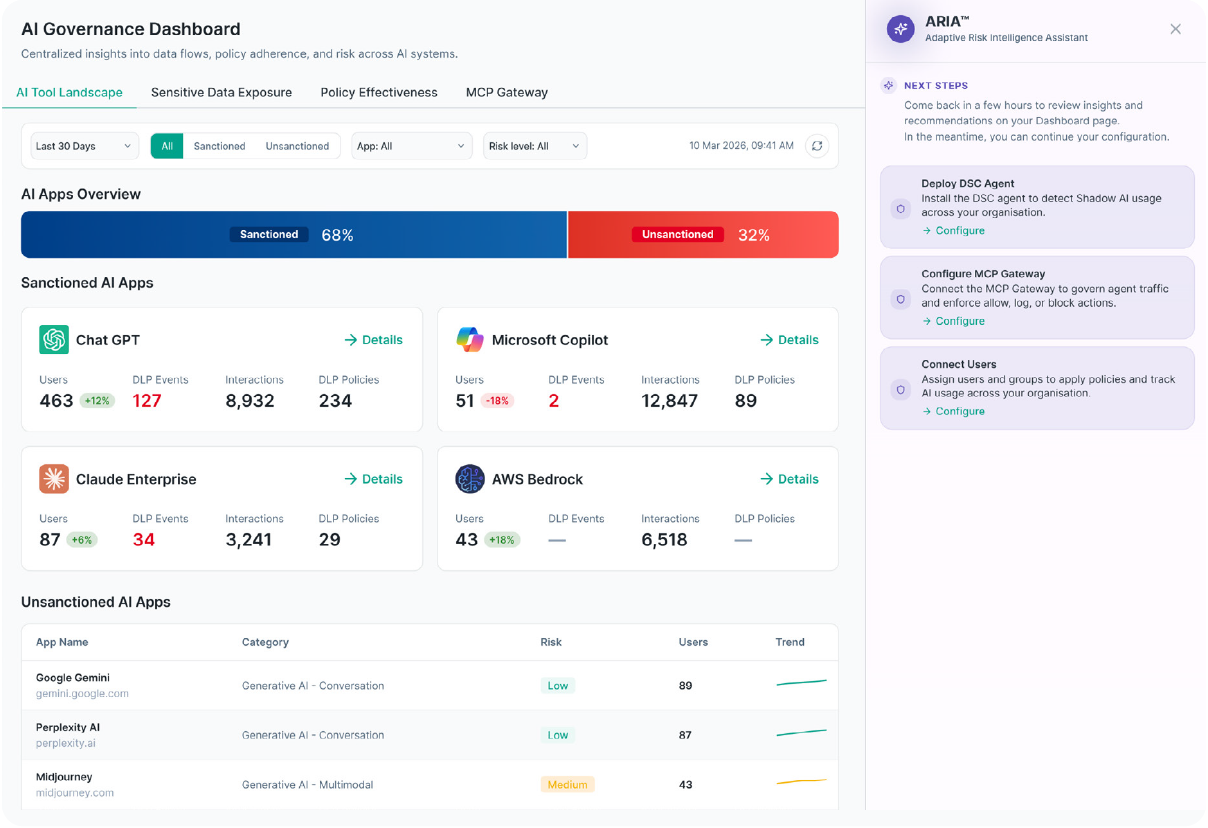
The Forcepoint AI Agent Gateway sits as the required intermediary between cloud-resident AI agents and the SaaS applications they call, currently in early access ahead of general availability. No agent holds direct application credentials. Each one is registered with a defined scope of approved tools, issued short-lived tokens and subject to instant revocation without rotating credentials on the application side.
Watch how Forcepoint AI Agent Gateway gives every AI agent its own identity, owner and access scope, so security teams always know who is acting, on whose behalf and within what limits.
Every agent-to-application response is inspected at field level, so sensitive values like customer records, source code or credentials get blocked or redacted before an agent can aggregate or transmit them. Write and delete operations can be held for human approval, routed through Teams, Slack or email, and every transaction, approved or denied, is logged immutably with the agent identity, triggering user, data classification and outcome attached. Inline application support spans core enterprise SaaS platforms at launch, with coverage expanding on a rolling basis.
Key features: Field-level data protection on agent-to-application traffic, credential brokering with no direct agent access to business apps, human-in-the-loop approval routed through Teams, Slack or email, detection that stops unusual record-volume queries at the execution layer before bulk extraction completes, instant token revocation, immutable audit trail supporting EU AI Act, GDPR, DORA and NIST AI RMF reporting requirements.
Pros:
- Enforces DLP-grade policy at the point an agent reaches sensitive data, using the AI Agent Gateway
- Existing DLP customers extend coverage to agents with zero reclassification
- Credential brokering means a compromised or manipulated agent cannot authenticate directly to a business application
- Full attribution chain across agent identity, human owner and data touched, not identity or runtime alone
Cons:
- Runtime behavioral detection is less mature than dedicated runtime security vendors
- Inline application support spans core enterprise SaaS platforms at launch, with coverage expanding on a rolling basis
Best for: Organizations that already run DLP or DSPM and want agent governance that extends existing data policy rather than standing up a separate identity or runtime tool.
Identity & Access Governance
These platforms secure agents at the identity layer: discovering every agent, scoping its permissions and replacing standing access with just-in-time grants.
Linx Security: Best for unified human, non-human and agent identity governance
Linx governs human, non-human and AI agent identities on a single platform, built around an identity graph that maps the full access path from any identity to the resources it can reach. Its MCP Gateway sits inline on agent tool calls, approving, blocking or routing each one for review.
Pros:
- Single platform across identity types
- Inline enforcement rather than after-the-fact reporting
- In-platform remediation
Cons:
- Smaller partner ecosystem than legacy identity vendors
- On-premises coverage is more limited than established enterprise platforms
Best for: Organizations wanting one identity governance platform across human and agent identities.
Astrix Security (Cisco): Best for purpose-built non-human identity security
Astrix, acquired by Cisco in 2026, extended its non-human identity foundation to agents with a four-method discovery approach covering registered agents, shadow agents and MCP servers.
Pros:
- Mature non-human identity discovery
- Agentless deployment
- Strong enterprise adoption
Cons:
- Runtime behavioral controls are newer than its discovery capabilities
- Roadmap and packaging are in transition following the Cisco acquisition
Best for: Organizations wanting dedicated non-human identity depth extended to agents.
Entro Security (SailPoint): Best for governing agents alongside the secrets they use
Entro, acquired by SailPoint in 2026, ties agent governance to secrets discovery, surfacing exposed credentials and API keys alongside agent identities across code, cloud and SaaS environments.
Pros:
- Combines secrets security with agent identity
- Agentless architecture
- Maps agents to human owners
Cons:
- Human identity governance sits outside its core scope
- Agent runtime controls are less developed than its secrets capabilities
Best for: Organizations where exposed secrets and credential sprawl are the primary agent risk.
Oasis Security: Best for just-in-time agent access
Oasis governs machine and agent identities with intent-based, just-in-time access, evaluating what an agent is trying to do before granting the access to do it.
Pros:
- Access granted before action rather than reactively
- Deep non-human identity lifecycle coverage
- Strong enterprise funding and traction
Cons:
- Centered on access rather than full human identity governance
- Runtime threat detection is secondary to access enforcement
Best for: Enterprises prioritizing pre-action access control over post-action monitoring.
Runtime Behavior & Posture
These platforms watch what an agent does while it acts, inspecting prompts, tool calls and outputs for signs of manipulation or misuse.
Zenity: Best for agent runtime observability
Zenity inventories agents across platforms and monitors step-level execution, correlating tool calls and memory access to catch manipulation that looks harmless at the prompt level alone.
Pros: Strong discovery and ownership attribution across platforms; detection findings map to recognized frameworks like MITRE ATLAS.
Cons: Not an identity governance replacement; best results depend on integration across the agent platforms in use.
Best for: Teams whose primary gap is visibility into what agents are doing in production.
Lakera (Check Point): Best for runtime guardrails and adversarial testing
Lakera, acquired by Check Point in 2025, pairs real-time runtime protection with continuous adversarial testing against prompt injection and jailbreak attempts.
Pros: AI-native, low-latency guardrails; continuous red-teaming pairs prevention with proactive testing.
Cons: Focused on runtime AI risk rather than identity or data governance; roadmap now sits within Check Point's broader platform direction.
Best for: Organizations whose top concern is prompt-level manipulation of agent behavior.
Enterprise Platforms Extending Coverage
These broad security suites have added agent-specific capabilities to existing portfolios, appealing to organizations that want consolidation over a standalone tool.
Palo Alto Networks (Prisma AIRS): Best for platform consolidation
Palo Alto has assembled AI and agent security across Prisma AIRS, its Protect AI acquisition and Cortex AgentiX, and extended into identity through its 2026 acquisition of CyberArk.
Pros: Broad coverage across runtime, identity and agentic operations; backed by large-scale threat intelligence.
Cons: Value is highest for existing Palo Alto customers; capabilities span multiple acquired products still being integrated.
Best for: Large enterprises already standardized on the Palo Alto platform.
Microsoft (Entra Agent ID + Defender): Best for Microsoft-native environments
Microsoft extended Entra to give agents first-class directory identities alongside humans and workloads, with Defender and Purview extending threat protection and data governance to AI usage.
Pros: Native fit for Microsoft-centric environments; agent identity managed in the same directory as everything else.
Cons: Coverage thins meaningfully outside the Microsoft ecosystem; capabilities are still evolving quickly.
Best for: Organizations standardized on Microsoft Entra, Defender and Copilot.
CrowdStrike: Best for unified identity security across human, non-human and agent identities
CrowdStrike Falcon Next-Gen Identity Security unifies protection across identity types, mapping non-human identities and agents to human owners and flagging orphaned or over-permissioned accounts.
Pros: Unified with existing endpoint and identity threat detection; continuous, risk-aware authorization.
Cons: Most valuable for organizations already on the Falcon platform; some capabilities depend on integrations still rolling out.
Best for: Existing Falcon customers wanting agent identity folded into their current stack.
Key Features to Look for in an Agentic AI Security Solution
Discovery scope. The platform needs to find every agent, including shadow deployments and MCP servers, not only the ones registered in a console.
Data-layer enforcement. Identity and runtime controls narrow what an agent can reach and how it behaves, but neither stops sensitive data from leaving through an approved action. Confirm whether the platform inspects data at the point of transmission, not just the identity making the call.
Credential handling. Determine whether agents hold direct application credentials or whether a broker sits between the agent and the systems it calls. Direct credential access turns a compromised agent into a compromised standing credential.
Human-in-the-loop controls. High-risk actions, like a write or delete against a production system, should be able to route to a human approver rather than executing automatically.
Audit and attribution. Every agent action should resolve to both the agent identity and the human who triggered it, with a record detailed enough to support compliance reporting under frameworks like the EU AI Act and NIST AI RMF.
Why Agentic AI Security Is a Different Problem Than Traditional AI Security
Generative AI security largely addressed a single moment: what a person types into a prompt and what a model returns. Agentic AI removes the person from that loop entirely. An agent reads a file, calls an API, writes to a database or triggers a workflow, often chaining several of those steps together without a human reviewing any individual one. The Cloud Security Alliance survey also found 85 percent of organizations already run agents in production, most commonly for task automation, research and developer assistance, while two-thirds cannot reliably attribute agent actions back to the agent or the human behind them.
That shift moves the security question from “was this prompt or response safe” to “was this action, and the data it touched, authorized.” Identity governance and runtime monitoring each address part of that question. Data-layer enforcement addresses the part neither one reaches: what actually happened to the sensitive information once the agent got to it.
What to Consider When Choosing an Agentic AI Security Solution
- Where does the platform enforce, not just observe? Discovery and monitoring produce visibility. Confirm whether the platform can actually block, redact or hold an action, not only report on it after the fact.
- Does it extend policy you already have, or require a new taxonomy? Organizations with existing DLP or identity programs should weigh whether an agent security platform inherits that investment or duplicates it.
- What happens to credentials? Ask directly whether agents hold application credentials or whether access is brokered and short-lived.
- How does it handle shadow agents? Confirm discovery extends beyond registered, sanctioned agents to ones built or connected without security's knowledge.
- What's the compliance story? Confirm the platform produces audit records detailed enough for the specific regulatory frameworks your organization answers to.
Why Forcepoint Leads on Data-Centric Agentic AI Security
The rest of the field governs the agent, either its identity or its runtime behavior. Forcepoint governs the data the agent touches, using the same classification and policy engine already protecting data across email, web and endpoint. Identity platforms can tell you an agent is authorized. Runtime tools can tell you an agent is behaving normally. Neither one can tell you what actually left in the response.
That distinction matters most for organizations that already have a data security program in place. Existing Forcepoint customers extend AI governance without standing up a new tool or rebuilding a classification taxonomy from scratch, the same policy that already protects a customer record in an email protects it when an agent reaches for that record instead. Explore Forcepoint AI Data Security to see how that extension works in practice.
Forcepoint can help secure AI throughout your organization. Talk to an expert today.

Lionel Menchaca
Lire plus d'articles de Lionel MenchacaLionel Menchaca has covered data security at Forcepoint since 2020, writing about DLP, DSPM, insider risk and AI security for security and IT leaders. He works with Forcepoint X-Labs threat researchers to turn their findings on emerging threats, from AI-targeted supply chain attacks to prompt injection, into practical guidance, and he leads the company's editorial strategy across the blog and the X-Labs newsletter. Before Forcepoint, Lionel founded and ran Dell's corporate blog for seven years and spent two decades helping enterprise tech companies explain security, cloud and AI.
- AI Agent Security: Govern the Team You Never Hired
Dans l'article
 AI Agent Security: Govern the Team You Never Hired Lire le Livre Électronique

X-Labs
Recevez les dernières informations, connaissances et analyses dans votre messagerie

Droit au But
Cybersécurité
Un podcast couvrant les dernières tendances et sujets dans le monde de la cybersécurité
Écouter Maintenant