
Forcepoint AI Agent Gateway
Agents Are Multiplying.
Are You Ready?
Forcepoint AI Agent Gateway stands between every agent and every application it calls, enforcing what agents can reach, what they can read and what requires human approval to push forward.
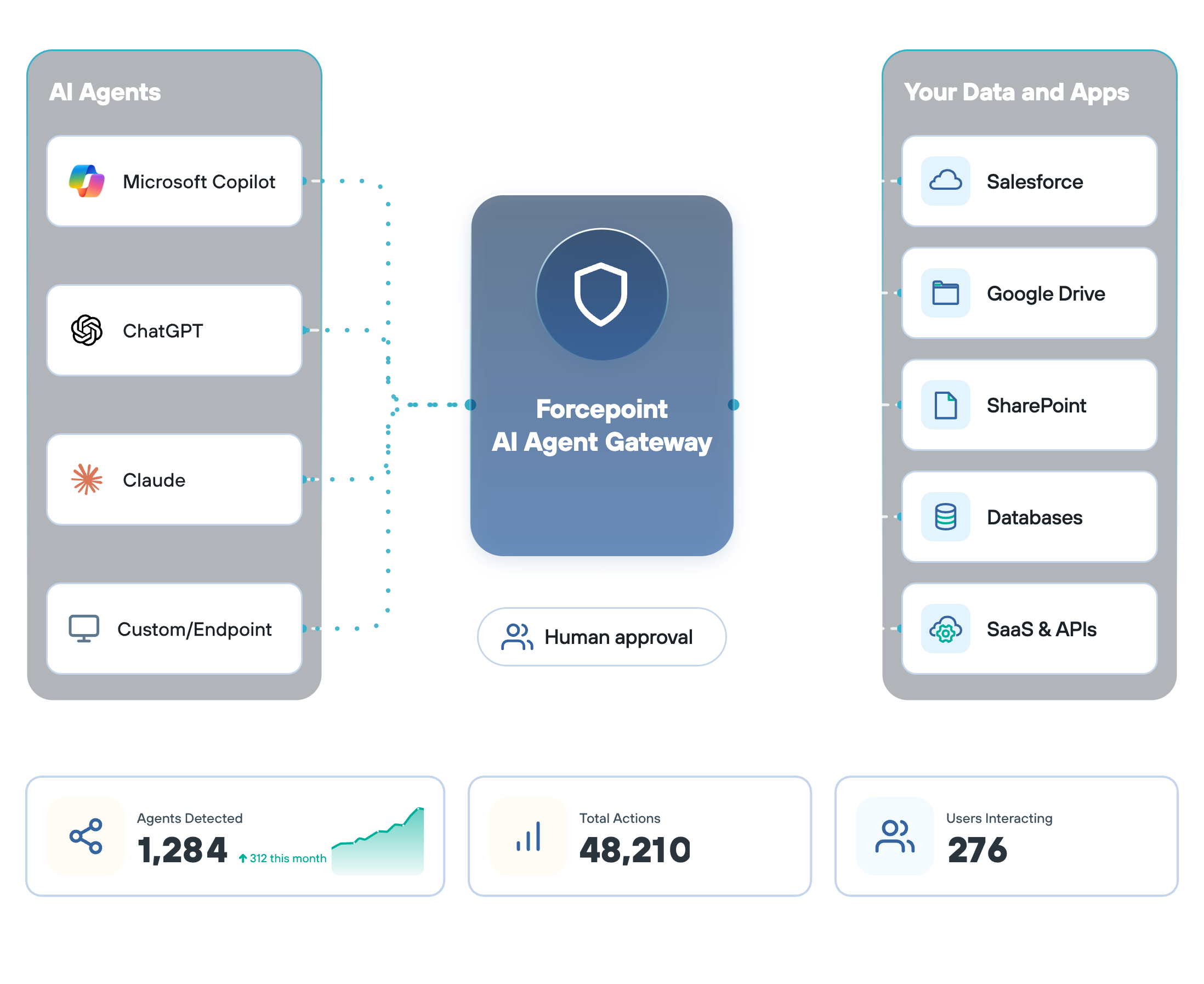












Forcepoint AI Agent Gateway:
Secure Every Agent
Let AI agents work in your environment without giving up control over your data, applications or business operations. Forcepoint AI Agent Gateway provides a security enforcement layer between every agent and the systems it connects to, governing credentials, sensitive data and consequential operations.
Control What AI Agents Access and Do
Forcepoint AI Agent Gateway surfaces every agent operating across your organization and enforces what they can access, what data they can read and what actions require a human, with an audit trail for each interaction.

See Every AI Agent in Your Environment
Build a centralized registry of every agent, providing full visibility prior to enforcement.

Stop Risky Agent Actions in Real Time
Enforce policy when an agent acts, before credentials are exposed or sensitive data is read.

Ensure Accountability for Every Action
Generate a complete, immutable record of every agent-to-application transaction.
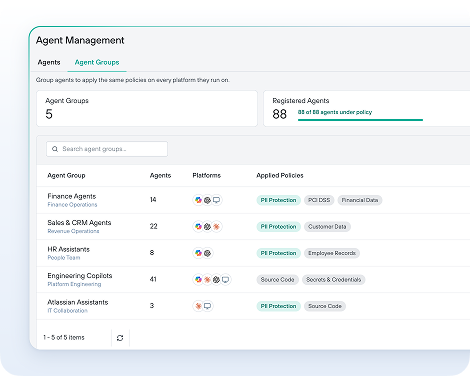
Extend Your Data Security Policies to AI Agents
AI agents introduce new ways for sensitive data to be accessed and shared across enterprise applications. As part of the Forcepoint AI Data Security platform, Forcepoint AI Agent Gateway extends existing data protection policies to agent interactions, maintaining consistent security controls as AI agents access applications and sensitive information.
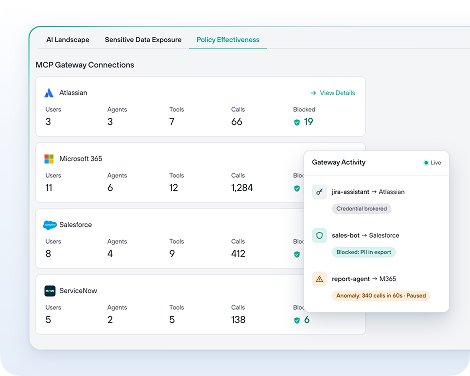
Enforce Security Policies Between AI Agents and Your Data
Forcepoint AI Agent Gateway sits between AI agents and the business applications they access, providing a centralized point for security enforcement. By brokering credentials, inspecting data exchanges and detecting anomalous activity, the Gateway prevents unauthorized access and sensitive data exposure across agent interactions.
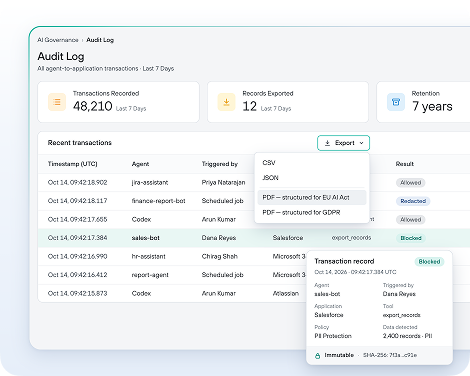
Generate Audit Trails That Hold Up to Scrutiny
Maintain detailed records of agent activity, including agent identity, initiating users, tools invoked, timestamps and policy decisions. Export audit logs in CSV, JSON or PDF to support security investigations, demonstrate policy enforcement and simplify compliance reviews.
Why Forcepoint AI Agent Gateway
Register Agents and Control Their Permissions
Register connected agents, associate them with owners and restrict their access to only approved tools and operations.
Protect Application Credentials
Broker application access using temporary, revocable credentials rather than handing agents persistent access.
Require Human Approval for High-Risk Actions
Hold designated high-risk operations for review before execution while allowing routine approved operations to proceed.
Track Agent Activity and Policy Decisions
Capture agent interactions, including identities and operations, and make the records available for investigation and reporting.
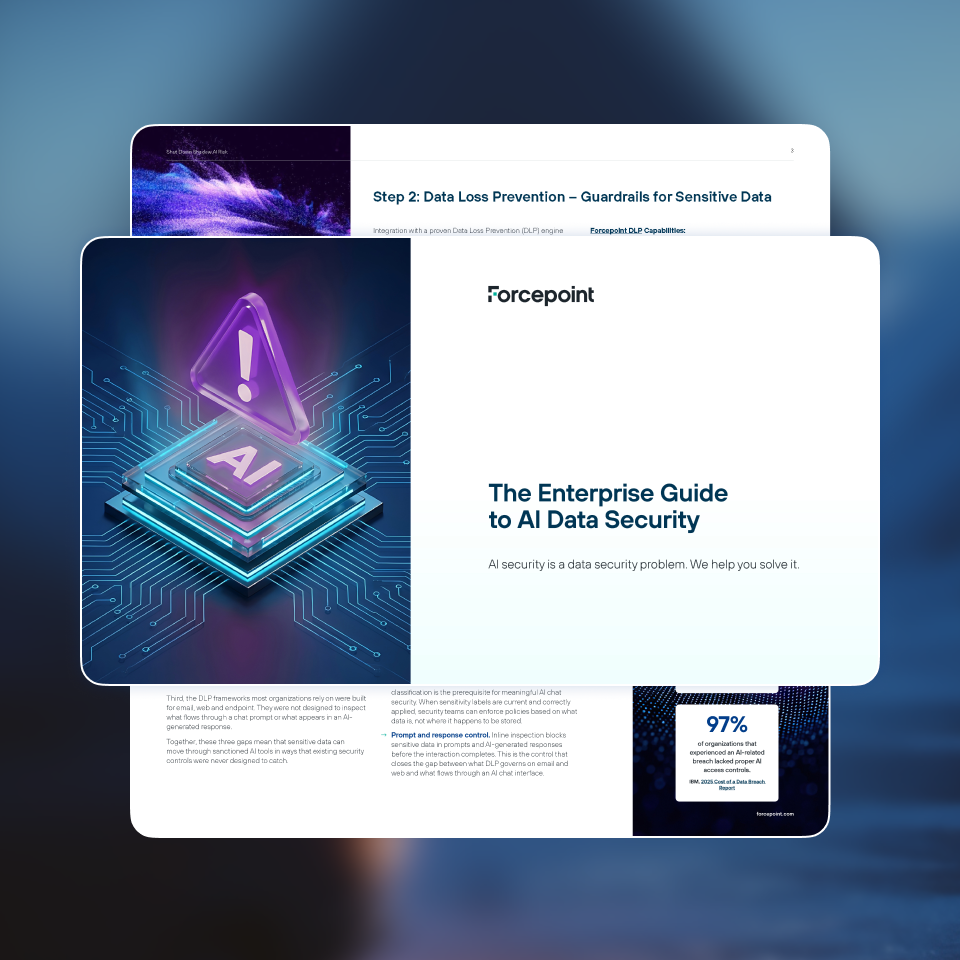
The Enterprise Guide to AI Data Security
Discover how Forcepoint secures data across sanctioned AI, shadow AI and autonomous agents on a single policy framework.
Govern Every Agent. Secure Every Interaction.
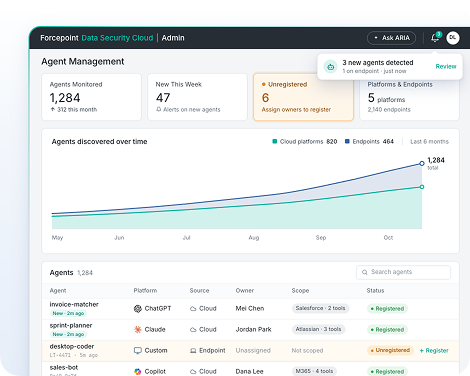
Identify every AI agent running on sanctioned platforms and endpoints. Register each with an owner and defined scope, and get alerts when new agents appear.
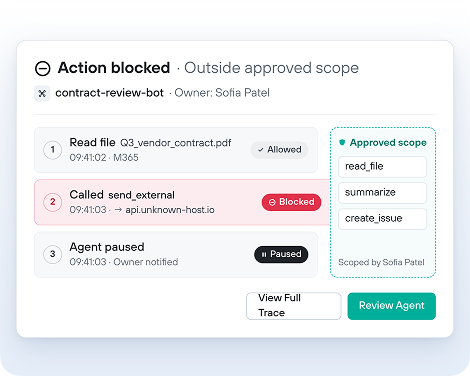
Agents can be manipulated by content they process. The Gateway limits every agent to approved actions so none can exceed its boundary.
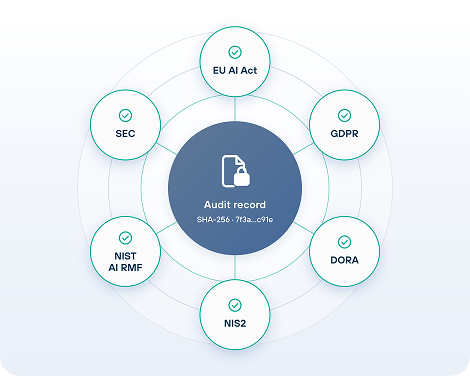
Every agent interaction generates an immutable audit record structured for EU AI Act, GDPR, DORA, NIS2, NIST AI RMF and SEC disclosure requirements.
Forcepoint AI Agent Gateway Works Well With
Frequently Asked Questions
What is an AI agent security platform?
An AI agent security platform governs what AI agents are permitted to access and do within an enterprise environment. Unlike tools built to monitor human AI interactions, an agent security platform addresses the specific risks agents introduce: they operate without a human reviewing individual steps, they accumulate permissions at deployment and hold them indefinitely, and they can be manipulated by content they were asked to process. Forcepoint AI Agent Gateway is the AI agent security platform component of the Forcepoint AI Data Security suite. It sits between every agent and every business application it calls, brokering credentials, inspecting data at the field level and enforcing what agents can do before they do it.
How is Forcepoint AI Agent Gateway different from identity and access management (IAM)?
IAM confirms identity. It does not evaluate intent or inspect what happens when a confirmed identity acts. Most AI agents run on shared service accounts, which means IAM cannot distinguish one agent's action from another's, let alone determine whether a specific query is appropriate given the data involved. Forcepoint AI Agent Gateway addresses the gap IAM isn’t built to close: it brokers credentials so no agent holds them directly, enforces scope at the tool level rather than the account level, inspects every application response at the field level before the agent reads it and holds consequential operations for human review. The two capabilities are complementary rather than overlapping.
How does AI Agent Gateway protect against prompt injection attacks?
Prompt injection works by embedding instructions in content an agent processes: instructions that redirect the agent's next action, often in ways neither the deploying organization nor the triggering user intended. Forcepoint AI Agent Gateway does not rely on the agent to detect or resist the manipulation. Instead, it enforces what the agent is permitted to do at the execution layer, regardless of what it was instructed to do by content it processed. An agent that has been manipulated into attempting to forward records to an external address cannot complete that action if forwarding records externally falls outside its registered scope. The enforcement happens at the point of action, not at the point of manipulation.
How does AI Agent Gateway help organizations meet AI compliance requirements?
Every agent-to-application transaction processed through Forcepoint AI Agent Gateway generates a complete, immutable audit record: agent identity, triggering user, tool called, data classification, policy decision, fields blocked or redacted, record count and timestamp. Records export in CSV, JSON and PDF and are structured to address what EU AI Act Article 12, GDPR Article 30, DORA, NIS2, NIST AI RMF and SEC disclosure requirements each ask for. The audit trail covers both human and agent AI interactions, so organizations produce a single exportable compliance record across their entire AI environment rather than maintaining separate records per tool or per interaction type.
Does AI Agent Gateway require reclassifying data before it works?
No. Forcepoint AI Agent Gateway runs on the same DLP classification already in place across the Forcepoint AI Data Security platform. The policies and classifiers protecting sensitive data in human interactions — prompts, file uploads, email attachments — extend directly to what the Gateway inspects in agent-to-application responses. Organizations that already use Forcepoint DLP policies extend those policies to AI agents immediately, with no reclassification program and no new console to manage.