10 Best DSPM Tools Compared: Comprehensive Guide for CISOs
0 分の読み物

Lionel Menchaca
Data sprawl across multi cloud, SaaS and AI systems makes it hard to answer basic questions like where sensitive data lives and who can access it. Data Security Posture Management (DSPM) tools close that gap by finding sensitive data everywhere, scoring its risk and guiding teams to fix exposures before attackers or auditors find them.
This guide compares 10 of the best DSPM tools in market, with a focus on cloud security DSPM tools and cloud data security across AWS, Azure, Google Cloud and the SaaS stack. You will see how vendors differ on automated discovery, AI driven classification, data access governance, SaaS remediation and DSPM for AI, along with core DSPM capabilities and common use cases.
Key Takeaways
Ten DSPM tools stack up differently on coverage, classification accuracy and how well they turn findings into fixes.
- This guide compares 10 leading DSPM tools across cloud, hybrid and on-premises environments, scored on classification accuracy, access governance and integration depth.
- Environment coverage is the real differentiator. Most tools scan cloud data only, so hybrid and on-premises support separates enterprise-ready platforms from point tools.
- AI-driven classification outperforms regex and keyword matching because it reads content and context together, which cuts the false positives that bury real risk.
- Effective risk scoring correlates sensitivity, exposure, entitlements and data movement, so security teams fix the highest-risk exposures first instead of working a flat alert queue.
- Classification alone does not reduce risk. The strongest DSPM tools connect findings to enforcement through native DLP, DDR and permissions remediation.
What is DSPM?
How We Evaluated These DSPM Tools
To build this list, we researched every DSPM vendor the same way. For each one, we reviewed:
- Public product documentation, including datasheets, technical docs, pricing pages and release notes
- Independent analyst evaluations, such as the IDC MarketScape and the Gartner Market Guide for the category
- Verified user reviews and ratings on G2, PeerSpot and Gartner Peer Insights
- Each vendor's publicly documented integrations, deployment options and platform coverage
We scored every vendor, including Forcepoint, against the same criteria: breadth of coverage across environments, classification accuracy, integration with the wider security stack, deployment flexibility and ease of management. Placement on this list cannot be bought. No vendor paid to be included or ranked.
Capabilities change fast in this market. We review and update this list frequently. This post was last reviewed in September 2026.
Vendors below are listed alphabetically. Yes = fully supported, Partial = partially supported, No = not supported.
| Vendor | Customizable AI/ML Classification | On-Prem & Hybrid Support | File-Level Permissions Analysis | Unstructured Data Hygiene | Privacy & Compliance Automation | DLP-Grade Labeling & Fingerprinting | Risk Prioritization and Breach Impact |
|---|---|---|---|---|---|---|---|
| BigID | Partially supported | Supported | Supported | Supported | Supported | Partially supported | Supported |
| Cyera | Partially supported | Unsupported | Supported | Partially supported | Supported | Partially supported | Supported |
| Forcepoint DSPM | Supported | Supported | Supported | Supported | Supported | Supported | Supported |
| Microsoft Purview | Partially supported | Partially supported | Partially supported | Partially supported | Partially supported | Partially supported | Partially supported |
| Netskope | Unsupported | Unsupported | Supported | Partially supported | Partially supported | Unsupported | Partially supported |
| Palo Alto (Prisma Cloud) | Unsupported | Unsupported | Supported | Partially supported | Partially supported | Supported | Partially supported |
| Rubrik | Unsupported | Partially supported | Supported | Supported | Partially supported | Unsupported | Supported |
| Securiti | Partially supported | Partially supported | Supported | Supported | Supported | Partially supported | Supported |
| Varonis | Partially supported | Partially supported | Supported | Supported | Supported | Partially supported | Supported |
| Zscaler | Unsupported | Unsupported | Supported | Partially supported | Partially supported | Unsupported | Partially supported |
Ratings reflect Forcepoint's review of public vendor documentation, analyst reports and verified user reviews as of August 2026. Capabilities in this market change quickly. Confirm current functionality directly with each vendor before making a purchase decision.
10 Best Data Security Posture Management (DSPM) Tools
Forcepoint DSPM: Best DSPM Tool for Hybrid Cloud Data Security
Forcepoint DSPM is the best fit for security teams that need one platform covering multi cloud, SaaS and on-premises data. It pairs continuous visibility into sensitive data with guided workflows that reduce exposure without slowing the business, and its AI Mesh classification engine reads content and context together across regulated and business critical data. Because it is part of the Forcepoint Data Security Cloud platform, DSPM findings connect directly to DLP, CASB and Data Detection and Response.
Independent reviews support this placement. Forcepoint DSPM holds a 4.5 out of 5 rating on Gartner Peer Insights, and Forcepoint is recognized in the Gartner Market Guide for Data Security Posture Management. The IDC MarketScape named Forcepoint a Leader in its Worldwide DLP 2025 Vendor Assessment, which specifically called out the platform's DSPM and AI Mesh classification capabilities.
Key features:
- Automated data discovery across cloud services, SaaS apps and file stores
- AI Mesh classification for content and context across regulated and business critical data
- Permissions analysis that flags risky data such as public links or overshared folders
- SaaS remediation workflows that fix overexposed data at scale
- Risk prioritization that correlates sensitivity, exposure and access to estimate financial impact
Forcepoint: 4.5 out of 5 (25 ratings)
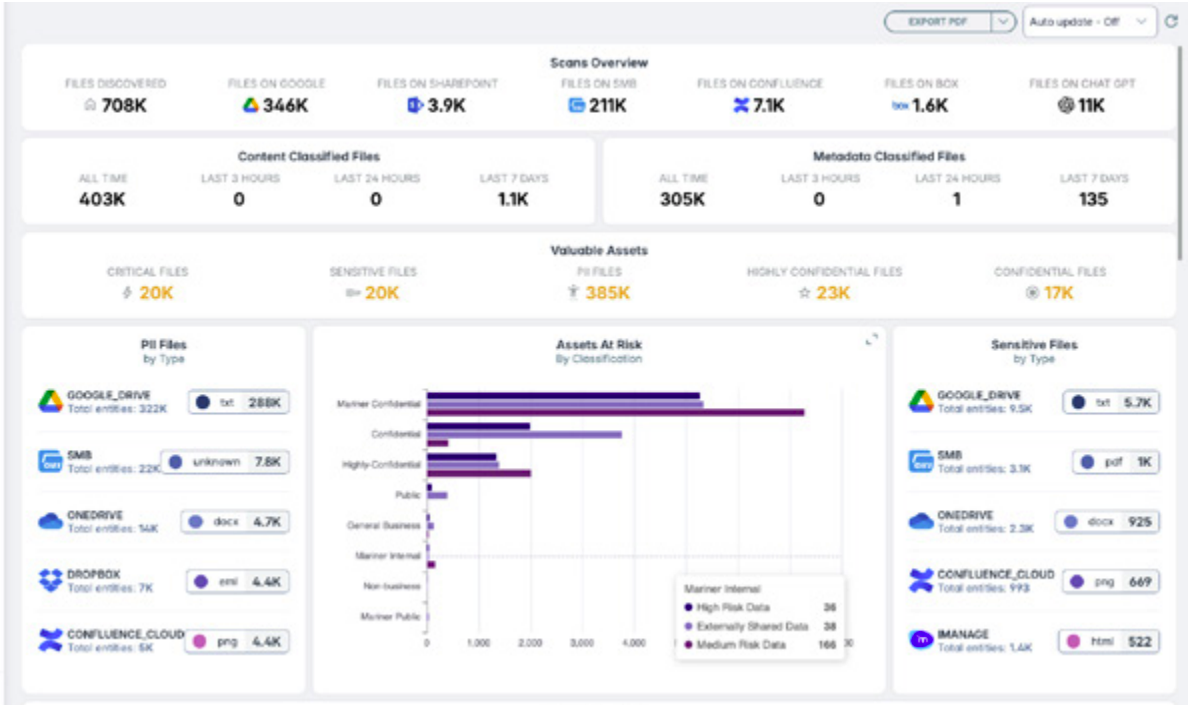
Forcepoint DSPM console
Pros
- Strong hybrid coverage across cloud, SaaS and on-prem
- Deep integration with Forcepoint DLP, CASB and DDR
- Mature AI classification and guided remediation workflows
Cons
- Best fit for teams that want DSPM as part of a unified data security platform
- May feel broad for organizations that only want a narrow DSPM point tool
Varonis: Best DSPM Tool for Microsoft Centric Unstructured Data
Varonis is the best DSPM tool for organizations that want deep file-level visibility across Microsoft 365 and other collaboration platforms. Varonis specializes in unstructured data hygiene across SharePoint, OneDrive and similar tools, giving security teams a detailed view of who can access which files and how. Varonis has shifted to a cloud-delivered control plane, so its strengths show up most clearly in organizations ready for SaaS-based data security.
Key features:
- Granular file level permissions analysis across Microsoft 365 and other file systems
- High fidelity unstructured data hygiene with rich insights into stale, orphaned and overshared data
- Strong privacy and compliance automation to support regulated data in collaboration tools
- DLP grade labeling and fingerprinting to track and protect sensitive content over time
Varonis: 4.8 out of 5 (896 ratings)
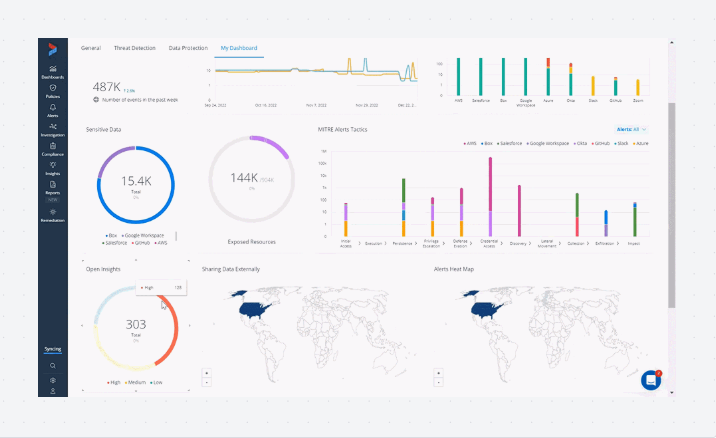
Image credit: Varonis
Pros
- Very strong at mapping who has access to which files and why
- Well suited to Microsoft centric environments with heavy collaboration usage
- Mature reporting and dashboards for privacy, audit and governance teams
Cons
- Cloud first architecture can be a challenge for organizations that need flexible on prem and hybrid DSPM options
- Focus on file and collaboration data may require other tools for broader DSPM coverage across all cloud data stores
Microsoft Purview: Best DSPM Option for Microsoft Centric Environments
Microsoft Purview is the best DSPM option for organizations that have standardized on the Microsoft stack and want data governance built into that ecosystem. Microsoft Purview provides data security, governance and compliance capabilities across Microsoft 365, Azure and related services, with expanding multi-cloud connectors reaching into AWS and Google Cloud. DSPM style visibility here is part of a broader compliance suite rather than a standalone product, so capabilities outside the Microsoft ecosystem tend to be partial.
Key features:
- Deep integration with M365, SharePoint, OneDrive and Azure services
- Label-driven classification and policy enforcement
- Governance and compliance features that use Microsoft identity and access controls
- Expanding connectors for AWS and Google Cloud data sources
Microsoft Purview: 4.3 out of 5 (29 ratings)
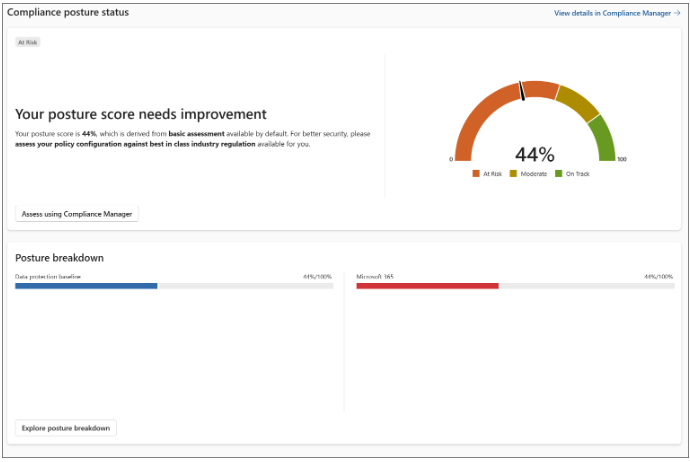
Image credit: Microsoft
Pros
- Strong native coverage in Microsoft environments
- Integrated compliance tooling and reporting
Cons
- Limited reach beyond Microsoft services without added complexity
- May be less attractive for multi-vendor cloud strategies
Palo Alto Networks Prisma Cloud: Best for Integrated Cloud and Workload Security
Palo Alto Networks Prisma Cloud is the best fit for security teams that want data posture folded into a broader cloud workload protection platform. Its DSPM capabilities, added through the 2023 acquisition of Dig Security, extend visibility to sensitive data stored in cloud services and managed data stores, correlating that risk with workload and identity findings across multi cloud environments.
Key features:
- Multi cloud coverage for workloads, infrastructure and data
- Correlates risks across data, identities and workloads
- Uses policy driven controls and guardrails for cloud native teams
Palo Alto Networks (Prisma Cloud): 4.5 out of 5 (251 ratings)
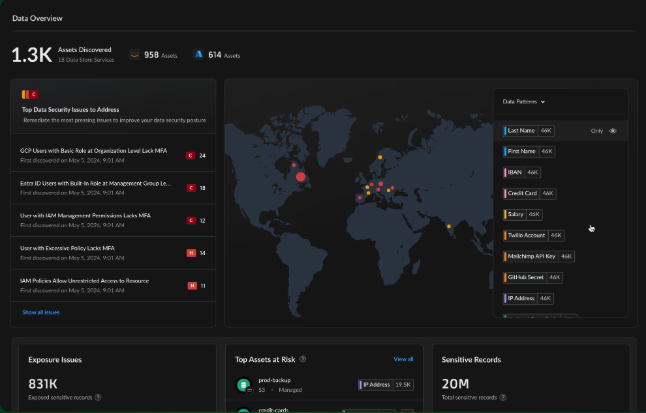
Image credit: Palo Alto
Pros
- Broad platform that goes beyond DSPM
- Strong multi cloud support and ecosystem
Cons
- Can be complex for teams that only need DSPM
- May require significant rollout effort to unlock full value
Netskope: Best for Inline Cloud Security and SaaS Posture
Netskope is the best fit for organizations that want DSPM built into an existing SSE deployment rather than run as a separate tool. It integrates DSPM with CASB and inline traffic controls, giving visibility into data in popular SaaS and collaboration tools and letting teams enforce sharing, download and access policy from a single platform.
Key features:
- Integrates DSPM with CASB and SSE capabilities
- Provides visibility into data in popular SaaS and collaboration tools
- Enforces policies for sharing, download and access from a single platform
Netskope: 4.5 out of 5 (622 ratings)
Pros
- Strong for SaaS centric environments
- Tight link between DSPM findings and inline policy enforcement
Cons
- Less emphasis on deep discovery in non-SaaS data stores
- On-prem and legacy coverage may require other tools
Zscaler: Best DSPM Tool for SSE Focused Deployments
Zscaler is the best DSPM tool for organizations that already run Zscaler as their cloud security and access layer and want data posture insight from the same provider. It links data discovery and classification to user and app context and applies policy controls that account for both content and access posture, though this functions as a supplementary capability rather than a purpose-built DSPM product.
Key features:
- Integrates DSPM with secure web gateway and zero trust access
- Links data discovery and classification to user and app context
- Applies policy controls that account for both content and access posture
Zscaler: 4.5 out of 5 (74 ratings)
Pros
- Well aligned with zero trust and SSE strategies
- Unified policy approach across data in motion and at rest
Cons
- May be less comprehensive for deep scanning across non-integrated data stores
- Some DSPM features depend on broader Zscaler ecosystem adoption
Rubrik: Best for Backup Centric Data Security Posture
Rubrik is the best fit for organizations that already use it for backup and recovery and want to reuse that footprint for data security posture. Its DSPM capabilities build on backup snapshots to surface sensitive data and ransomware risk across hybrid and on-prem environments that still depend on file servers.
Key features:
- Discovers and classifies sensitive data in backup copies
- Surfaces ransomware and data risk insights from backup telemetry
- Supports hybrid and on-prem environments that still depend on file servers
Rubrik: 4.4 out of 5 (42 reviews)
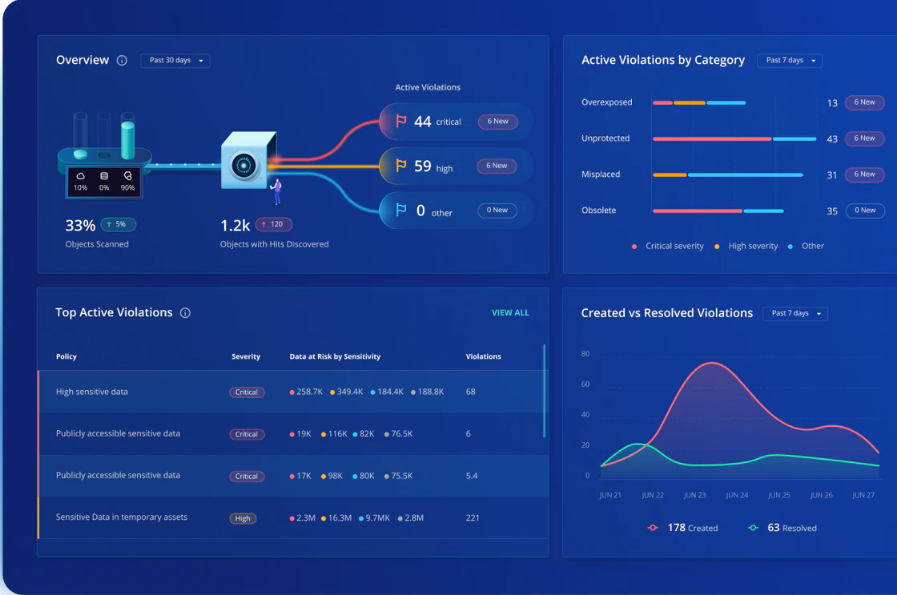
Image credit: Rubrik
Pros
- Strong fit where Rubrik is already deployed
- Good alignment with backup and recovery strategies
Cons
- Visibility model is tied to backups rather than live systems
- May not match real time DSPM needs for every use case
BigID: Best for Data Catalogs and Privacy Governance
BigID is the best fit for organizations driven by privacy, data governance and catalog programs that need posture insight across large, complex data estates. It excels at classifying data across mainframes, data lakes and structured environments, pairing broad discovery with privacy and governance workflows and flexible integrations for data-driven programs.
Key features:
- Broad data discovery and cataloging across many sources
- Strong privacy and governance workflows
- Flexible integrations for data driven programs and analytics
BigID: 4.6 out of 5 (81 reviews)
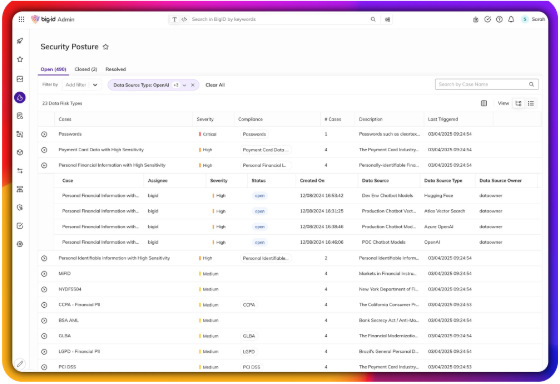
Image credit: BigID
Pros
- Good fit for data governance and privacy led initiatives
- Rich metadata and catalog features
Cons
- May require configuration to focus on narrow DSPM scenarios
- Can feel heavyweight for small security teams
Cyera: Best DSPM Tool for Fast Cloud Scale Discovery
Cyera is the best DSPM tool for cloud-first organizations that want fast, broad visibility without a heavy deployment lift. Cyera is an agentless, cloud-native platform built for rapid time to value across major cloud providers and SaaS apps, though on-premises coverage is only partial and requires connectors and proxies.
Key features:
- Fast cloud scale discovery and classification
- Focus on sensitive data mapping and access analysis
- Dashboards built for security teams that need quick answers
Cyera: 4.6 out of 5 (335 ratings)
Pros
- Quick to deploy and useful for fast visibility
- Strong cloud centric design
Cons
- Less emphasis on on-prem and legacy environments
- May require other tools to cover niche data sources
Securiti: Best for Privacy First DSPM and Data Security Posture
Securiti is the best fit for teams that need DSPM closely aligned with privacy, consent and regulatory obligations. It combines data security with privacy intelligence and AI governance, mapping sensitive data across hybrid and multi-cloud environments, though on-premises coverage is partial compared with its cloud capabilities.
Key features:
- Privacy centric DSPM and data security features
- Discovery and classification aligned with privacy programs
- Workflows that support privacy, governance and security teams
Securiti: 4.7 out of 5 (52 ratings)
Pros
- Strong privacy and compliance alignment
- Good fit for regulated industries
Cons
- May be more than needed for teams that only want DSPM
- Broad feature set can add complexity for small deployments
Top 6 Capabilities of DSPM Tools
Choosing among DSPM tools is easier when you focus on the capabilities that matter most. The best data security posture management tools share features that turn raw data scans into action and directly strengthen cloud data security.
Automated data discovery across cloud and SaaS
DSPM starts with the ability to find data wherever it lives. Automated data discovery across cloud storage, databases, SaaS apps and file systems replaces ad hoc inventories and one time audits.
Accurate AI driven classification and labeling
Finding data is not enough. DSPM tools need to understand what that data means. AI driven classification separates routine content from high value assets such as financial records, health data and intellectual property.
Data access governance and permissions analysis
Many breaches stem from simple access issues. Strong DSPM tools analyze who can access each dataset, how that access is granted and where it violates least privilege for true data access governance.
Risk scoring and prioritized remediation workflows
Good DSPM platforms translate posture data into clear risk signals. They score issues based on sensitivity, exposure and business impact then group related problems into workflows.
SaaS and cloud remediation to fix overexposed data
Visibility is only useful if teams can act on it. Top DSPM tools connect directly to SaaS and cloud platforms so they can remove public links, adjust group memberships or change permissions in a controlled way.
DSPM for AI and GenAI safety
AI adoption introduces new data flows and risks. DSPM for AI extends posture management to training data, prompts and AI outputs, using accurate data classification for AI so sensitive information does not leak into public or shared models.
AI-Powered DSPM vs DSPM for AI: Two Different Problems
These terms get used interchangeably, and answering the wrong one is how tools miss the mark.
- AI-powered DSPM is about using AI to do DSPM better: reading content and context to classify structured and unstructured data accurately and cut the false positives that bury real risk. Forcepoint's AI Mesh classification architecture is built for this, learning from your business to classify with minimal configuration. Learn how it works in the AI Mesh overview.
- DSPM for AI is about protecting the data that AI systems touch: finding overexposed files before Microsoft Copilot or ChatGPT can surface them, and keeping sensitive data out of prompts, RAG sources and training sets. See DSPM for AI for the full approach.
A mature program needs both, because accurate classification is what makes AI governance downstream precise rather than generic.
Identifying Breach Impact Quickly
When an incident hits, the question is not only what happened but which sensitive data was affected and who could reach it. Forcepoint DSPM answers this by correlating classification with access and exposure: risk scoring and financial-impact estimates rank the most exposed data, the ransomware exposure analysis dashboard shows where sensitive data sits in harm's way, and pairing DSPM with DDR adds near real-time monitoring and file lineage so teams can scope impact as events unfold.
How AI Powers Data Discovery in DSPM
Traditional data discovery relied on regular expressions and keyword lists. That approach flags anything that looks like a credit card or a national ID number, which mislabels routine documents and buries real findings in noise.
AI-powered DSPM uses language models to read content and context together. It can tell the difference between a random string of digits and an actual payment record, recognize a confidential merger document from the business meaning of its language rather than a single keyword and surface sensitive data hidden in free text, chat histories, code repositories and AI prompts.
That broader reach is why AI has become the default engine for DSPM data discovery across cloud, SaaS and on-prem systems. Forcepoint DSPM uses AI Mesh classification, which combines deep neural networks with small language models tuned to regulated and business critical data.
How AI Prioritizes Data Security Risks
Finding sensitive data is only half of the job. Once a DSPM tool has discovered and classified data, teams still need to know which exposures to fix first, which is where AI-driven risk prioritization comes in.
Modern DSPM platforms correlate four signals to rank each finding. Sensitivity of the data, such as PII, PHI, secrets or intellectual property. Exposure of the location, including public links, open buckets and misconfigurations. Entitlements, which show who or what can reach the data, including over privileged users and dormant service accounts. And movement, which tracks where the data has traveled and where copies now sit.
Combining these signals surfaces the smaller set of high risk combinations that warrant immediate action instead of a flat list of alerts. Forcepoint DSPM applies this logic inside guided remediation workflows, so security teams move from a ranked risk view to an executed fix within the same platform.
How to Choose an Effective DSPM Tool for Your Organization
Every organization's data landscape is different so there is no single best DSPM tool or one size fits all cloud data security product. The right choice depends on your cloud strategy, regulatory obligations and existing security stack.
Start by mapping where your most important data lives today and where it is going. Consider cloud platforms, SaaS applications, on-prem systems and AI initiatives. Then look for a DSPM solution for cloud security that aligns with that architecture instead of forcing you into a narrow model.
When you evaluate vendors, focus on three questions. Can the tool discover and classify your data accurately. Can it surface real risk instead of noise. Can your teams use its workflows and reports without adding friction to the business.
5 Most Common Use Cases for DSPM Tools
DSPM delivers the most value when it is mapped to clear, repeatable business outcomes. Leading programs anchor their strategy around well-defined DSPM use cases that tie data posture improvements to risk reduction and compliance goals.
Finding and fixing risky data exposure in multi cloud and SaaS
Organizations often discover sensitive data scattered across cloud storage buckets, databases and SaaS file shares with inconsistent controls. DSPM tools help teams locate that data, understand its sensitivity and highlight where it is exposed to users or networks that do not need access.
Cleaning up overshared collaboration data in tools like M365 and Salesforce
Collaboration tools make it easy to share files with entire departments, external partners and the public internet. DSPM tools analyze sharing patterns, links and group memberships to show where sensitive data has been left open so teams can safely reduce exposure.
Strengthening compliance and audit readiness
Regulations expect organizations to know where regulated data resides and how it is protected. DSPM platforms map sensitive data to systems, owners and controls then provide reports that support audits and internal reviews.
Governing AI and GenAI data flows
AI and GenAI introduce new ways for sensitive data to move. DSPM for AI helps teams see which datasets feed AI models, surface shadow AI usage and understand how prompts and outputs handle sensitive information.
Identifying breach impact and understanding which sensitive data was affected
When a suspected incident hits, teams need to know which sensitive records were touched and which identities had access. DSPM tools speed up that answer by tying sensitive data classification to access context and duplicate and shadow copies, so responders can scope the breach in hours rather than weeks.
See Forcepoint DSPM in Action
Forcepoint DSPM brings these capabilities together in a platform designed for hybrid and multi cloud enterprises that need consistent cloud data security. It delivers fast discovery across cloud, SaaS and on-prem, powered by AI Mesh classification that understands content and context.
Because Forcepoint DSPM integrates with DLP, CASB and DDR, teams can move from visibility to enforcement using a common set of policies and signals. DSPM for AI extends that protection to modern AI use cases, helping teams monitor AI usage so security leaders can support innovation with confidence.
If you want to see how your data posture looks today and where you can reduce risk, connect with Forcepoint to see Forcepoint DSPM in action and explore your own environment.

Lionel Menchaca
の記事をもっと読む Lionel MenchacaLionel Menchaca has covered data security at Forcepoint since 2020, writing about DLP, DSPM, insider risk and AI security for security and IT leaders. He works with Forcepoint X-Labs threat researchers to turn their findings on emerging threats, from AI-targeted supply chain attacks to prompt injection, into practical guidance, and he leads the company's editorial strategy across the blog and the X-Labs newsletter. Before Forcepoint, Lionel founded and ran Dell's corporate blog for seven years and spent two decades helping enterprise tech companies explain security, cloud and AI.
 Gartner®: Buyer’s Guide for Data Security Posture ManagementGet Your Copy

X-Labs
インサイトや分析、ニュースを直接お届けします