Your AI Security Plan Covers One Risk and Misses Two
0 Minuten Lesezeit

Lionel Menchaca
An HR team builds a Copilot Studio agent to answer basic policy questions and grants it read access to the department's SharePoint site. Nobody scopes that access before launch. The agent inherits everything already sitting there, including executive compensation files, board minutes and M&A planning documents. No one broke in. No policy was violated. The agent did exactly what it was configured to do, and what it was configured to do reached much further than anyone intended.
That is not a hypothetical edge case. It is one of three risk categories security teams are navigating right now, and most are only prepared for one of them.
AI Security Is a Data Security Problem
In a cybersecurity resilience survey Accenture published in 2025, 77% of organizations said they lack the foundational data and AI security practices needed to protect their models, data pipelines and cloud infrastructure. That gap exists because most security programs still treat the file as the unit of risk. AI breaks that model. A single sensitive record can enter a prompt and come out the other side as an email draft, a slide and a chatbot response, three new objects derived from one sensitive source, none of them classified or tracked.
The Three Places AI Already Touches Your Data
Shadow AI rarely enters through the front door. Employees adopt tools because they work, not because IT reviewed them, then connect those tools to Google Drive, Slack or a CRM through OAuth, often without anyone noticing for months. A harder version of the same problem shows up in browser extensions, AI coding assistants and locally installed agents that interact with enterprise systems through APIs, with no interface for a security team to monitor at all.
Sanctioned AI tools carry a different version of the same risk. Microsoft Copilot respects existing file permissions, but those permissions were set years before anyone considered what an AI assistant could instantly surface and summarize. An employee who uploads a spreadsheet to an approved AI tool to reformat it has not done anything wrong. The sensitive data inside it still left the organization's control the moment it was submitted.
Agentic AI raises the stakes again. IDC projects the number of active AI agents in enterprises will climb from roughly 28.6 million in 2025 to 2.2 billion by 2030, nearly an 80-fold increase in five years. Most agents inherit the permissions of whoever built them, permissions that were never scoped for autonomous use. An agent takes action without a human reviewing each step, which makes the gap between what a team can see and what it can stop widest exactly where the consequences are highest.
What the Enterprise Guide to AI Data Security Covers
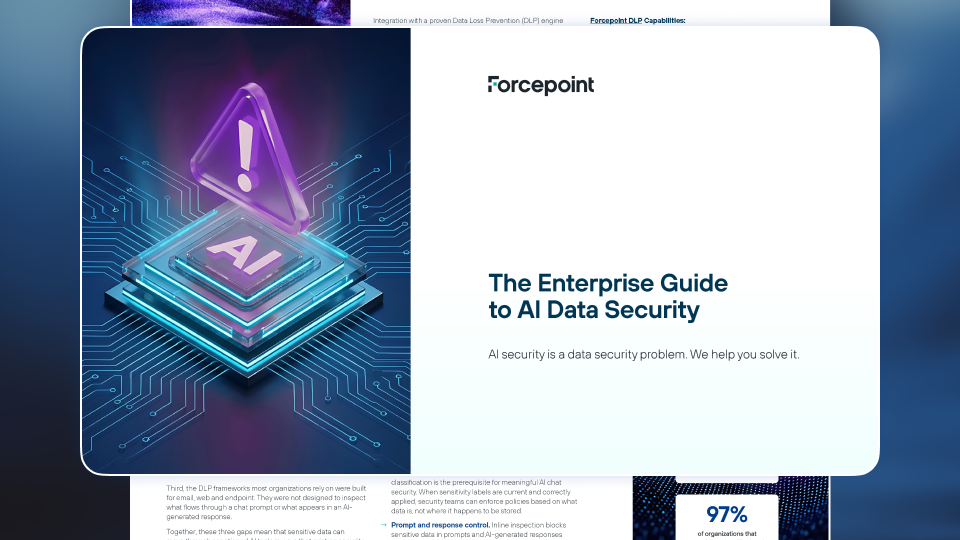
Forcepoint built The Enterprise Guide to AI Data Security around these three risk categories, and it does not stop at describing them. For each one, it lays out a practical control checklist security teams can start applying immediately:
- For shadow AI: how to build a continuously updated inventory of every AI tool in use, detect agent activity running as browser extensions or locally installed tools and tell a sanctioned platform apart from an employee routing sensitive content through a personal account on that same platform
- For sanctioned AI apps: how to classify sensitive data automatically, inspect prompts and AI-generated responses inline before an interaction completes and build a consolidated audit trail that holds up under regulatory review
- For agentic AI: how to scope least-privilege access before an agent deploys, require human approval for high-risk actions like external data transmission and move agents off standing credentials and onto short-lived, revocable tokens
The guide closes with a seven-stage AI Security Maturity Model, starting at data discovery and ending at continuous assurance and compliance, so a security team can place its program honestly on the map instead of guessing what to prioritize next.
Built for Leaders Who Need a Plan, Not Another Warning
CISOs, data security leaders and compliance teams don't need another explanation of why AI is risky. Most already know. What they need is a sequence to follow: where to look first, what controls actually close the gap and how to show measurable progress to a board that is asking about AI governance now, not next year.
The Enterprise Guide to AI Data Security gives that sequence, grounded in how Forcepoint AI Data Security already governs shadow AI, sanctioned apps and agentic AI from a single platform. It is not a theoretical framework built in a vacuum. It is a starting point for the next conversation with your board, your compliance team or whoever is asking what your organization is actually doing about AI.
Get the Full Framework
The Enterprise Guide to AI Data Security breaks down shadow AI, sanctioned apps and agentic AI risk one at a time, with a practical control checklist for each and a seven-stage maturity model to benchmark your program against.

Lionel Menchaca
Mehr Artikel lesen von Lionel MenchacaLionel Menchaca has covered data security at Forcepoint since 2020, writing about DLP, DSPM, insider risk and AI security for security and IT leaders. He works with Forcepoint X-Labs threat researchers to turn their findings on emerging threats, from AI-targeted supply chain attacks to prompt injection, into practical guidance, and he leads the company's editorial strategy across the blog and the X-Labs newsletter. Before Forcepoint, Lionel founded and ran Dell's corporate blog for seven years and spent two decades helping enterprise tech companies explain security, cloud and AI.
- The Enterprise Guide to AI Data Security
In dem Artikel
 The Enterprise Guide to AI Data SecurityE-Book lesen

X-Labs
Get insight, analysis & news straight to your inbox

Auf den Punkt
Cybersicherheit
Ein Podcast, der die neuesten Trends und Themen in der Welt der Cybersicherheit behandelt
Jetzt anhören