The 5 Hidden SaaS Data Risks Every CISO Must Address
0 min read

Neeraj Nayak
Cloud adoption and SaaS proliferation have redefined how organizations operate. But they’ve also introduced a new class of risks that many security leaders underestimate. Today, SaaS applications hold the crown jewels of business: customer data in Salesforce, financials in Google Drive, source code in GitHub, contracts in Box, and almost everything in Microsoft 365. Yet as SaaS usage accelerates, so do the blind spots.
According to Gartner, enterprises use an average of 125+ SaaS apps, but IT teams typically know about only a third of them. Add the rise of Generative AI tools like ChatGPT and Copilot, often accessed without governance, and the risk landscape becomes even more complex. Sensitive data is flowing into prompts, shared through unmanaged channels, and stored in places security teams can’t see. For CISOs, CIOs, and InfoSec leaders, this isn’t just a technical challenge. It’s a business risk with compliance, reputation, and financial implications.
The Hidden Risks that Break Data Classification at Scale
Even strong classification programs can feel complete until they hit real-world complexity like shared access, fast-moving pipelines and inconsistent labels across systems. Before you operationalize controls, it helps to pressure test the model against the most common failure points that quietly increase exposure.
Here are the five most critical blind spots and why they matter now.
1. Excessive Permissions: Who Has Access and Who Shouldn’t?
Access sprawl is inevitable in fast-moving organizations. Roles change, projects end, yet permissions often remain. Employees also take shortcuts by granting broad access, such as “anyone with the link,” instead of assigning permissions based on actual business needs. The likelihood of leaks and compliance failures rises sharply when former employees or contractors retain access to sensitive data.
Why this matters: Excessive access rights expand the attack surface, increasing the risk of insider misuse and external compromise.
2. Sensitive File Exposure: Links that Shouldn’t be Public
External collaboration is essential, but persistent public or external links can quietly become a compliance nightmare. Files shared for a project often remain exposed long after it ends. These exposures often go unnoticed until discovered during audits or, even worse, after a breach.
Why this matters: Public links bypass authentication, leaving sensitive data open to anyone with the URL.
3. ROT Data: Redundant, Obsolete and Trivial Content Still Carries Risk
SaaS platforms become digital landfills over time. Outdated project files, duplicate content, and trivial data accumulate quietly, consuming storage and hiding sensitive information. Forgotten files often contain regulated data, such as PII and financial records, that still fall under GDPR, HIPAA, or PCI DSS obligations.
Why this matters: ROT increases breach risk and inflates storage costs without adding business value.
4. Structured Data Exposure: Databases and Data Lakes
As enterprises accelerate SaaS, cloud, and AI adoption, structured data remains a critical blind spot. Sensitive records (PII, PHI, financial, etc.) in databases and data lakes are often broadly accessible to analysts, contractors, or service accounts without consistent visibility or policy enforcement.
Why this matters: Structured data is often the most regulated and the hardest to govern at scale. Without proper controls, enterprises risk massive compliance failures and insider threats.
5. Generative AI Risk: The New Frontier
Generative AI tools like ChatGPT and Copilot promise productivity gains. But they also introduce unprecedented data risks. Employees pasting confidential data into prompts or uploading sensitive files for analysis can inadvertently expose proprietary information to external systems.
Why this matters: AI-driven interactions create new vectors for data leakage and regulatory non-compliance, often outside the scope of traditional SaaS security controls.
The Real SaaS Challenge is Control
These risks aren’t hypothetical. They’re happening every day in organizations that believe their SaaS security posture is strong. The reality? Traditional perimeter-based tools can’t see into SaaS environments, and native app controls rarely provide the depth or consistency enterprises need. Meanwhile, regulatory pressure is mounting, and attackers are exploiting these blind spots with increasing sophistication.
For CISOs and security practitioners, the challenge isn’t just visibility. It’s control.
- How do you discover sensitive data across hundreds of SaaS apps and structured stores?
- How do you identify overexposed files, revoke risky permissions, and prevent sensitive information from flowing into unmanaged AI tools?
- And how do you do all this without slowing down the business?
Learn How to Close the SaaS Security Gap
SaaS adoption and AI innovation aren’t slowing down. Neither are the risks. Addressing these five hidden threats is no longer optional. It’s a strategic imperative for every enterprise that values its data, reputation, and compliance posture.
Ready to see how leading organizations are tackling these challenges?
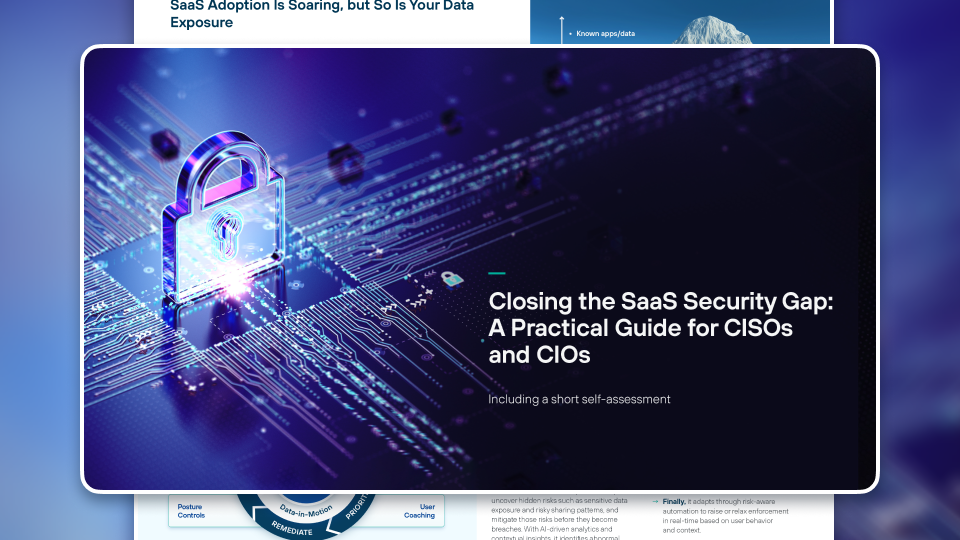
Download our free eBook: "Closing the SaaS Security Gap: A Practical Guide for CISOs and CIOs" to:
- Learn how to discover and classify sensitive data across SaaS and structured environments
- Explore Forcepoint’s self-aware data security approach for protecting data everywhere without slowing business
- Benchmark your readiness with a built-in 5-question self-assessment and evaluate your SaaS data security posture

Neeraj Nayak
Read more articles by Neeraj NayakNeeraj Nayak is a Senior Product Marketing Manager at Forcepoint. With over a decade of experience in the cybersecurity industry, Neeraj has a deep understanding of cybersecurity solutions including SASE, SSE, CASB, ZTNA, DLP, and SD-WAN. Neeraj previously held product marketing roles at Netskope, Skyhigh Security and Lookout. Neeraj holds an MBA degree from IIM Mumbai and an Engineering degree from NIT Warangal.
 Closing the SaaS Security Gap: A Practical Guide for CISOs and CIOsRead the eBook

X-Labs
Get insight, analysis & news straight to your inbox

To the Point
Cybersecurity
A Podcast covering latest trends and topics in the world of cybersecurity
Listen Now